Showing posts with label Bill Parcells. Show all posts

Friday, July 11, 2014

NY Jets #69 - Part 3

I just finished reading David Peace's Red or Dead, about Liverpool's legendary manager during the 60's and 70's, Bill Shankly. If you can get past the style of its narration, then it's worth reading as an epic, with its relish for naming names and numbers and statistics, its love of ritual and routine, and because its protagonist is an epic hero.

"Shanks," as he was called, is depicted as a struggler in his relentless dedication to a singular purpose. He is, perhaps, the only real example of an athlete or coach whose main motivation was to satisfy the fan, the supporter, most specifically the ones cheering in the Kop, the "Spion Kop," the stands behind the goal, so named (also in different stadiums throughout Britain) for its resemblance in angle to a hill lost in the Boer War. In the novel Shankly prefers a modest salary but is willing to force management's hand to pay out for the best players from around the country. Just to bring championships to the fans he loved so much.

One of my favorite moments in the novel comes when Shankly advises Ian St. John, his most valued and loyal player in the 1960's, that he must begin to think about retirement. The "Saint," as he's called, was Scottish like Shankly, and the two have a wonderful showdown about the indignity of time's passage. Shankly suggests to the aging St. John that he should consider an apprenticeship in managing. The Saint agrees, but adds that he already knew Shankly was trying to phase him out during the previous holidays, when club's assistant secretary forced him to take a smaller Christmas turkey, the ones meant for the reserves, rather than the big ones set aside for starters:

"After I had scored one hundred and seventeen goals for Liverpool Football Club. That was when I knew. When your bloody lap dog gave me a tiny fucking budgie for my Christmas turkey. That's when I knew I was finished with this club. But still I played for you on Saturday. And I still scored for you on Saturday. Didn't I, Boss? For you. For you, Boss."

If you try reading it aloud in a Scottish burr, it's even better. Shankly is always quick to correct his players that they do not play for him, but for the Kop. But it never works. His players love him and will do anything for him. Next to their salary, they care more about him than they do the fans. His players are always surprised when their time has come, and they can't believe someone they love so much would end it all for them. But the game must end, as all games do, and the athlete's time on the field is always briefer than he thought it would be. 

"It comes to us all," Shankly says in response to the Saint. "It comes to us all, son."

***

A touchdown, no? 
Jason Fabini #69 is depicted here in a very important moment in the history of professional football. It's 1998, and he has just helped Vinny Testaverde across the line in a last second, fourth down goal-line touchdown to beat Seattle at home, at the Meadowlands, 32-31.

Fabini was a part of the best Jets offensive line since the unsung heroes of Super Bowl III - Hill, Herman, Schmitt, Rasmussen and Talamini. Along with Kevin Mawae, Jumbo Elliott, Todd Burger, and Matt O'Dwyer, Fabini was on a front line that allowed Testaverde to be sacked only 19 times (Steve Young was sacked 48 times!) and gave him the space to be the second leading passer in the league. The Jets won their division for the first time since 1969 and were one quarter away from going to the Super Bowl. To me, all of this is as if it were yesterday.

If the local network in Philadelphia didn't show the Jets game on my analog TV, then I was mostly out of luck. There was no way of following the game online in the ways there are today, so I was left to try and pick up Howard David and Dave Jennings on WFAN or WABC. I did that day, and heard both of them broadcast Vinny's touchdown. But then they hemmed and hawed over the replay, wondering whether or not the ball had actually crossed the line. Turns out it didn't, but because there was no official instant replay, the touchdown stood, and the Jets moved to 9-4. Had it been reversed, the Jets might not have ended up with home field advantage in the second week of the playoffs. On the basis of this and several other official miscues that season, challenges were officially made available to coaches the following season. Hence the red flags that you know and love so well.

But Fabini is doing the right thing in the above picture. He's possibly aware that his quarterback didn't make it, but he's signaling touchdown anyway. (During the World Cup, it seems that the squads with the greatest number of flopping players usually had the best chance of winning. Even Bill Shankly is depicted in Red or Dead as ordering his trainer Bob Paisley to paint a bruise on the scrotum of one his players who was being investigated by the FA for punching an opponent. Shankly's player apparently insisted that the guy he punched had been grabbing his balls.)

Shankly's players are depicted as solid blocks of stone, surprised when their Boss benches them, and easily manipulated when he goads them to see things from his point of view. He flatters them when he needs to. The Saint has a rare perceptive eye. Jason Fabini and his elder colleague Jumbo Elliott seem almost as if they speak of Peace's book when the following is quoted from a 2000 article from Gerald Eskanazi, just before the beginning of what would be a tumultuous season:

HEMPSTEAD, N.Y., Aug. 23— ''Are you trying to say I'm stupid?'' Jason Fabini said to Jumbo Elliott, his former mentor who is now his backup.
''No, it's just that I've got an I.Q. of 140,'' Elliott said today before downing a handful of protein powder. Then, he added, ''And went to the University of Michigan.''
Of course he's saying that Fabini is stupid. It could be argued too that Elliott's own haranguing might have been in defense of his own intelligence. Jumbo had just recently resolved the business surrounding his 1999 arrest for apparently punching a Long Island bar patron and urinating in the women's room sink. To give Fabini a little credit, the intonation of his question might have been, "Are you trying to say I'm stupid?" But Fabini was also arrested that night, along with Matt O'Dwyer - something that Messrs. Talamini, Rasmussen, Herman, Schmitt and Hill probably never experienced.

Jason Fabini is considered a member of the Jets Four-Decade Team. Here he seems to show himself to be a good chef. But here he is implicated, but not accused, in an enormous marijuana ring his brother ran out of one of Fabini's several homes in Indiana, presumably while Jason was out of town. Here is the record of a 2009 appeals case suggesting that now that since he was unable to play any further, he would need to modify his child support. The Internet is the enormous wasteland graveyard of our miserable indignities, especially those that mark our transition from active player to getting the "fucking budgie." But I remember too that when Jason Fabini was one of the blocks of stone opening for Curtis Martin and closing for Vinny Testaverde, he was great indeed. Our memories are more valuable than the Internet.

***

If there is any coach who ever inspired the kind of devotion from his players the way Bill Shankly did, then it would be Bill Parcells. Consider William Roberts #69. Roberts played 14 seasons on the offensive line - all for Parcells - with the Giants, the Patriots, and the Jets (in 1997). Roberts might have seen his arrival with the old boss as being business as usual, but he could not have missed the historical fact that the Jets have always been a place where good and great players come to metaphorically die (Leonard Marshall, Art Monk, Ronnie Lott). If any conversation resembled the one between Shankly and the Saint, it might have taken place in 1997, when Roberts' season and career were coming to a premature end. Perhaps he was called into the Great Tuna's office for one last chat. Like the Saint himself, did Roberts see the signs of it all ahead of time, or did it come to him as one great shock? Regardless, it comes for us all.

Thursday, July 7, 2011

NY Jets #53 - Part 2

There is an extraordinary pipeline that runs back and forth between the Jets and the New England Patriots.  Since 1997, they have traded coaches and stars back and forth.  Most of it, of course, has been to the benefit of the good people of West Connecticut, New Hampshire, Maine and Vermont (I guess), Rhode Island and Massachusetts and all other bandwagoneers.  Belichick was defensive coach for both teams, Parcells was Head Coach for both, and so was Pete Carroll.  Eric Mangini was Belichik's protege.  Curtis Martin went from New England to the Jets, making him the most valuable acquisition we've gotten out of the pipeline, but of course New England has enjoyed the greatest benefits in the larger sense.  Belichick - whom Parcells presumptuously appointed as Jets Head Coach when the old man "retired" to become GM in 2000 - takes a perverse pleasure in snatching up our seconds and making them firsts.  Like Danny Woodhead.

Former Patriot Larry Izzo #53 came to us in 2009.  Izzo was one of those players whom you hoped would turn Belichick's stomach when he was dressed in green, but then Izzo was found to have a spine injury that forced him to retire a couple of months later.  It was not to be.  I liked Izzo because he represented a kind of player for whom no opportunity is ever turned down; in other words, he is a special teams man with more special teams tackles than any human being alive.  We assume that this would apply to anyone in the CFL.  No offense, fellas, and no pun intended.  Finally, the famous story about Larry Izzo is that at training camp in his rookie year with Miami (1996, undrafted) Coach Jimmy Johnson said that only two players were guaranteed to make the team - Dan Marino and Larry Izzo.  No one knew who the second guy was; they do now, mostly.  But I think Jimmy Johnson liked to say the name - "Larry Izzo," with its connotations, sounding like some guy fallen off a truck, like some nobody whose name sounds like "zero." His name has been bothering me for a long time because I could not remember the larger significance of it.  But now I remember.  Though there is no known relation, "Izzo" was Vince Lombardi's mother's maiden name.  Pedigree asserted, albeit nominally.  Larry Izzo was the omega to Marino's alpha.  Each of them would make it to opening day.  In the universe, one cannot exist without the other.

****
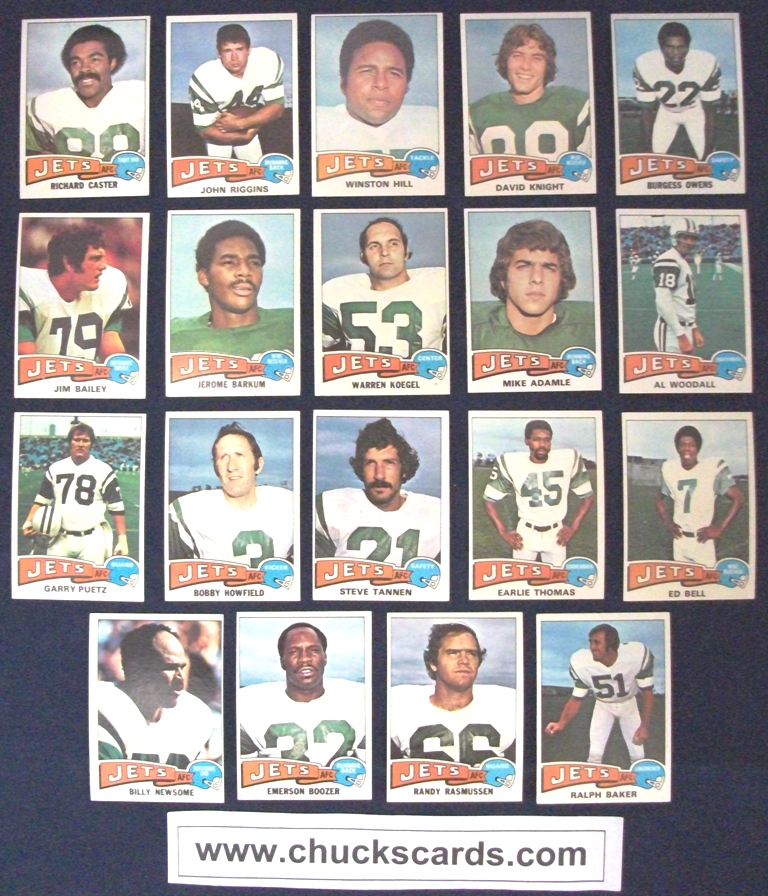
The 1975 Topps card of center Warren Koegel #53 immediately reminds me of a Presidential portrait, or even better, the famous painting of William Blake.  It's the image of a noble personage, a man looking hungrily beyond the the renderer's view.  Maybe that's the way he wanted it.  There weren't many "action" shots for that year's Topps cards.  Most of them were retreads from the years before or were reflective shots where the Jet players were asked to look off in the distance, and the players vacantly obliged.  Some have hands casually on both hips.  One or two try the lame, posed action shot - always amusing, for who are they defending against?  One or two look like they were taken during warm-ups at Foxboro the season before.  Among them all, Koegel's image looks like it belongs to a man who with a vision.  

His nickname was "Moose;" according to a rather detailed article on him for Coastal Carolina University in 2001 (where he was athletic director at the time), this nickname derives from the fact that he wore #14 as a Little Leaguer, the same number as "Moose" Skowron of the Yankees.  His Little League in Seaford, NY was very near the one I played for in North Merrick; what's incredible is that for someone as detail-oriented as I  (and about only a handful of things, mind you) I have no idea what numbers I wore in Little League, or even if I had a number at all.  That's bizarre.  It's another one for my mental health care professional.  

At any rate, Koegel (pronounced "ko-ghel," by the way) was director at Coastal Carolina and is apparently now in the same position at Jacksonville State.  Koegel was the offensive captain for Penn State in the late 60's and early 70's, with Jack Ham as defensive captain.  In the Coastal Carolina link above, there is an interesting detail about the end of Koegel's career in 1975.  He blew out his knee just before halftime in the away game against Kansas City, one of only three wins for the Jets that whole season.  His knee was repaired by Dr. James Nicholas, the eminent Merlin to Joe Namath's Arthur, the sports physician who enabled Joe to play longer than he could or should have.  "I haven't had any trouble with my knee since," Koegel says.  The irony is that Koegel's knee gave out before Joe's heavily braced ones did, which may be a testimony to Nicholas after all.  With the exception of John Riggins, the good doctor was sadly the most talented and able member of the team that year.

****
Out of Michigan State, drafted by the Jets in 2000, #53 Courtney Ledyard's KFFL profile through news releases looks like a journey back in immediate time.  In an instant, we know all the history we need to know, but nothing essential about the man - only the "transactions" of the quickly summarized past.  No looking through microfilm for us, or scrolling through the Reader's Guide to Periodical Literature, searching for "Ledyard, Courtney."  Those days are gone.  One link, one source.  That seems to be what it's all about.  At the above link, we begin with NFL Europe, where he was consigned in September 2001, and then to injuries earlier at the August 2001 camp, then his earlier re-signing in the spring of that year.  Such is Courtney Ledyard, whose name sounds like a band that toured with Lynard Skynard and Molly Hatchet.

****
Mike McKibben #53 arrived at Kent State two years after the shootings that marked the university in the historical mind.  What was it like then, and how did the jock culture at Kent State imagine itself in light of the countercultural community that the Troop G attacked?  How quickly did people need to move on there in order to move on with their lives?  Was it just a peripheral thing after a while, the way it is, probably, for students today?  People pass by the Prentice Hall parking lot to get to class and get on with their destiny.  


Mike McKibben graduated at a good time to join the Jets.  It would have been a good year for my Dad to join the team, and he was 41.  The jobs were available.  In 1979, McKibben's rookie year, the Jets broke even but could have done much better if not for the injuries that wore the team down to a nub.  Missing Pat Leahy alone cost them at least two games.  Mike McKibben became a starter very quickly, and it looks like he played at linebacker in all 16 games of that season.  He played less the year after that and then was out of the NFL.  He then played for Pittsburgh and then Denver in the USFL a year or two later.  Or vice versa.  

Oh c'mon, don't act like you remember their names right off the bat.  The Pittsburgh Maulers and the Denver Gold.  There you go.  There are no stupid questions here.  No one's judging you.  The interesting thing is that the Denver Gold practically replicated the Pittsburgh Steelers' uniform, while the Pittsburgh Maulers' purple logo looked like something out of the WPA.  Remember that the only stupid question is the one not asked.


"Ledyard, Courtney"

Sunday, July 3, 2011

NY Jets #52 - Part 3

In 1997, Thomas "Pepper" Johnson #52 got the call from Bill Parcells. Come join my latest experiment, he says, and the men often take the call and the one-way flight to wherever he is. New Jersey, Foxboro, New Jersey again, Dallas, Miami. There aren't really any players from Parcells' coaching days still active, though if Pepper Johnson could play, I'm sure Parcells would play him. But would Pepper play for him?


Johnson was one of Parcells' favorite defensive players, and considering how much the old man loves defense, that's saying a lot. I saw Pepper Johnson as a Scottie Pippen to Lawrence Taylor's Michael Jordan, if Jordan was a human basket case. Aren't all superstars, by definition, basket cases? Jordan may still appear as a relatively impenetrable star in Hanes ads, but the man is wearing a Hitler mustache. This point cannot be avoided any longer. Does no one on these ads care enough about their product to make him change this? Is the world's most self-assured man trying to see if, like Serbia, he can call contemporary Western civilization's bluff? Or is this some cry for help?

At first glance, Pepper appears to have been playing the role he needed to play as a Jet - as a Parcells man, keeping the program moving forward, playing a inspirational role. But who was he really coming back to New Jersey for in 1997? Answer: the same man for whom he also played as a Giant, and the same man for whom is a linebackers coach today - the Dark Lord, Bill Belichick.

This is why Pepper is now our enemy, though I will always recall him forlornly standing apart the night we lost the AFC Championship to Denver in January 1999. It was his last game with the Jets and his last as an NFL player, and he looked saddened for the way it had to end. I guess I'll never be really bitter about Pepper Johnson helping to make my life a living hell in New England over the past decade the way I should be.


***

1) When we are young, our parents notice details about us that become apocryphal bits of characterization. Johnson's nickname apparently comes from his preference as a child for putting pepper on his cereal. As with any good story, it doesn't matter if it's true or not.

2) Not many people recall Pepper Johnson's celebratory dance, which might be idiotically construed by officials today as "taunting." I used to do it all the time when I was a teenager didn't have anything better to do on the dance floor. It had the effect of producing the same effect that urinating on yourself does in a crowded room.

I can find no evidence of the dance online, and people often say they saw it for the first time at midfield at the end of Super Bowl XXI, but I remember seeing it earlier. It's hard to find a reference to it anywhere online, except in an LA Times article on Giants guard William Roberts and Pepper Johnson doing "The Dog," a dance they evidently learned at their alma mater, Ohio State. This must be the dance. They were dancing The Dog.

3) Did Keith Byars learn the dance? I still don't exactly remember how it goes. All attempts to find a video of it online have only produced films of dancing dogs. But anytime I feel angry at Pepper Johnson's devotion to Bill Belichick, I will be able to remember what Keith Byars did to Pepper in 1988. I've mentioned it before in reference to Byars. You will never see a 6'3" 250 lb man fly as far as Pepper Johnson did that day. That's what you get for not teaching a Heisman runner-up The Dog, he seems to say.

****

Steve Reese, LB, 1976 Bucs
In 1975, I saw linebacker Steve Reese #52 in in the program for two games for the Jets at Shea Stadium, against the Colts and Steelers. I remember seeing his face In 1976, I saw him play one game at Shea Stadium, this time as a Buccaneer against the Jets, and this was his picture in the program. The Jets won 34-0. That game was one of the two times the Jets' total offense went over 300 yards all season, and as bad as the Jets were that year, the 1976 Buccaneers have a very special place in the history of American sports in terms of ineptitude. They left even their skeptics in awe of how bad they were. It's time for somebody to make a major film about a winless team dressed in sherbet orange at the dawning age of American decline.

I remember looking at this head shot and wondering what it was like to play for teams as progressively poor as the 1975 Jets and then 1976 Bucs. By the age of seven, I had come to grasp and accept the reality of the Jets' losing with a new zeal but also with a sense of the humbling nature of human existence. The only consolation I might have taken was what many of us - even children - believed we were witnessing when the orange Bucs took the field - that some kind of history was being made, the kind that wouldn't be repeated for a long, long time. If you loved a losing team, as I did, then you were endeared to the Buccaneers. Other kids I grew up with were enamored of winners only, the Steelers and the Cowboys, or later the Broncos and the 49ers. As the song goes, some side with the leaves, some side with the seeds. If you loved only winners, you always loved only a winner. When you loved a loser, then you loved all the losers who turned it around, as the Bucs did in 1979. And I root for the Detroit Lions just as sympathetically as Besitkas roots for Pluto.

Wednesday, April 20, 2011

NY Jets #51 - Part 3

There were a collection of players drafted by the Jets in 1976 who were integral to the team's growth over the next few years.  Richard Todd was drafted in the first round; Shafer Suggs was drafted second, and Abdul Salaam was drafted seventh.  Greg Buttle #51 was drafted third.  He had the face of a player who was new to me in every way.  He had a little bit of the Dan Haggerty/Grizzly Adams look about him, gazing out upon the new frontier and finding solace in the ursine arms of Gentle Ben.  He was part of the New Way.  The post-Namath Jets - my Jets, not my Dad's - the team that I would watch be rebuilt from scratch, and damn, damn, damn if they didn't just kind of almost pull it off.

No more would I rely on my father's stories of leather-necked men like Al Atkinson, Ralph Baker, Verlon Biggs, Paul Rochester and Jim Hudson.  The Jets would be stocked with nothing but youth.  In terms of average age, the Jets were in 1978 the youngest team in the pros, which is why SI predicted that year they would go 1-15.  They broke even.  By then, Todd, Suggs, Salaam and Buttle were all starters, as were guys drafted in '77.  Buttle played for the Jets his whole career.  He is on the radio for the Jets, and you hear in his voice his North Jersey accent.  Here he offers what I feel is a nice little tribute to Shea Stadium as the Jets' home.  We never got to the game early enough to see what he recalls as throwing footballs into the stands and shaking hands with the fans, but Buttle is right about the closeness to the field.  Fans could get so close that they were right behind the players and couldn't see the game.  Hey, 51.  Move.  And the fact is that fans frequently ran onto the field during the game.  I saw one guy in 1980 run off with a helmet during an impossible Jets loss to the winless New Orleans Saints.

Like his predecessor in number, Greg Buttle came from Penn State, where he was a standout.  My first introduction to him was the home game against New England in his rookie season, which the Jets naturally lost 38-24.  Buttle recovered an Andy Johnson fumble for the first Jets' touchdown of the game, and then intercepted Steve Grogan to set up the second, all in the first half.  Enjoy the harpsichord and Jon Facenda's sonorous voice of God as he speaks at the 5:40 mark.  Facenda quotes Buttle as saying,

"They pay me to practice.  Sunday, I play for nothing."  Facenda adds:  "If all the Jet youngsters hold to that thought, the team will be headed  to the right direction."

Perhaps this is actually the way God looks at us.  If Roche can live up to his resolution to avoid cake in the middle of the day, he should be moving in the right direction.  But I cannot say.  I have no control.  I merely narrate his endeavors at the behest of Ed Sabol as if I can.    

I remember the off-duty cop in front of me turning around and hugging me when Greg Buttle scored that touchdown, his parka smelling like a mixture of cigarette smoke, aftershave, bourbon and leather seats - the smells of postwar men.  I remember his expression when he pulled away, of absolute surprise and delight, a look that I didn't know that a grown man could have.  I suppose I realized then and there what being a fan could do to a person.  The world of men as I had seen it from watching faces as I held my father's hand walking through Queens, was a loud, explosive, mustachioed, grumpy place filled with raspy voices.  My wife says that in the 70's she imagined that her adulthood would be filled with the hairy, grass-smoking people who wore tight white linen shirts and white bell-bottoms, walking along Malibu Beach, listening to Eagles and Carly Simon songs as they played on eight-track.  That's what she saw in her mind's eye as she grew up in Boston.  I imagined the adult world as the off-duty cops who sat in front of my Dad, whose expressions were made dour by the frown of their mustaches.  They were vigilant, dissatisfied, yet hazy all the same.   

I thought it was a world I would have to grow into, but then it never came to me.  It was actually a world in its death throes when I got to it, passing out of existence.  By the time I was an adult, sports was for families and (with the absolute exception of the Lincoln Field in Philadelphia) would no longer tolerate men who smoked cigars in the stands and snuck hard liquor into games.  That was the world of Shea, a place for angry men who waited amid deep sighs and bluster for an instant to turn briefly into children again.  It rarely happened.  But it could happen.  

****

A few years ago I was teaching a star athlete in my Honors English class, which is highly unusual.  Honors English in senior year is usually for the art kids, the kids who take European History and the ones who want to be teachers someday.  Athletes aren't really in that category, but this kid, a lettered track and soccer player, was probably my best student.

Except being the top kid in class wasn't enough for her.  She wanted more.  I don't give out 100% grades on papers, but I do give out A's.  I would give her A's - 93, 94 - but she wanted more.  "What's it going to take for me to get a 96?"  She asked.  "A 97?"

"Look," I told her, "you get good grades.  Why do you need more?"  I know it seemed silly to ask, but these were the highest grades.  She was a senior.  Other students in class were in the slack of spring, uninterested in doing better.  I had to worry about my 11th graders who were failing English in my other class, the ones who cut class and didn't do their homework or were suspended.  I confess I had become acclimated to senioritis in my battle with my juniors.  But not her.

"I need a push.  You have to push me," she said.

"But you already work hard," I said that.  "I recognize that.  I do."

"You don't understand.  You have to push.  You have got to make me give more.  I need to do more."

This is the way athletes are, I realized.  They relied on inspiration from people that mattered to them, and in this case, I was her coach.  I?  A coach?  Since I had never been a successful athlete, I didn't know what that would look like if I tried.  But I had read enough about effective coaches to know what to say next.

****

Bryan Cox #51 played for the Jets from 1998-2000 and was specifically brought to the Jets by Bill Parcells, who loved players whom most of the league had written off as washouts.  I always admired this about the coach, and I do feel like it is the only redeeming thing I can find about him remaining in me.  Consider Ottis Anderson, Jumbo Elliott, Vinny Testaverde - guys that Parcells kept going and working collecting a paycheck.  It always seemed as though these players could alternately mentor the younger players and also prove to the boss that they could still play - a matter on which, it seemed, the boss never seemed to appear entirely convinced.  That's the thing.  In the modern era, it takes a psychological artist to compel people to play for him and him alone.  As he moved from team to team, Parcells took these devotees with him.  Keyshawn Johnson, Richie Anderson and Testaverde all went to Dallas with him.  

Cox is now a defensive coach with the Dolphins, Parcells' current managerial home; it is also where Cox began his career in the early nineties.  In only his second year, he became one of the most feared linebackers almost overnight by recording 14 sacks.  He was the first player I ever saw wear that oversized neck protector.  In the context of the times in which he played, with the heated nature of the rivalry between Buffalo and Miami during that time (in which the Jets played only a bit role) Bryan Cox was seen as the man with the target on his back.  He took the field at Rich Stadium rather famously with his middle fingers extended.  It was hard to take his side, but it was enjoyable to see the fans of Buffalo aghast at him.

Were they so innocent?  This is not a conclusive (or speedy) link, but Cox suggested that the racist hate mail he received from Buffalo fans prior to the game so unnerved him that he behaved "like a child."  It might have been around the time Jack McDowell gave his own Yankee fans the bird.  Good times all around.  I remember taking a ride around Buffalo in a crowded car when I was on a business trip as a glorified assistant, and our tour guide referred to the neighborhood passing by as "where the blacks lived."  That was 1997, some five years after Bryan Cox flipped Buffalo off and became known afterwards an "out-of-control player."  When he came to Jets, I worried like the sensitive fan that I am about his "presence in the locker room."  Today he is a defensive coach and possibly moving up the ranks.  There you are.

My favorite story about him comes in two interpretations.  The first is from the time that the Jets were clinching the AFC East in beautiful 1998; Cox comes to his locker and Parcells has left a gift for him:  a gasoline can half-filled with water, with the simple message:  "Merry Christmas."  In a story about Parcells for 60 Minutes, Cox clarifies the gift by saying that the note also asked Cox if he has "any gas left in the can."  Did he have anything left to give?  The coach needed more.

****

I am through with Bill Parcells, but I knew what I needed to say to my student.  I sat down with her and examined several very specific places where her writing needed stylistic improvement and asked her, tentatively handing the paper back, "Is there any gas left?"

"What?" she asked.

"You heard me," I asked.  "Is there anything left?  Can you give me more?"

She narrowed her eyes.  Suddenly she wasn't in English class.  She was on the field, being pushed for more.  She knew I'm no more a coach than Rex Ryan is a professor of absurdist drama, but I was playing a role.  And she got it.

"Yes," she said.  And the next essay she wrote was not just her personal best but also the overall best of the year.  

Wednesday, May 5, 2010

NY Jets #44 - Part 1

There are many reasons why numbers are so important to sports fans. Whether it be about scores, statistics, years, schedules, prices or uniforms, numbers are immutable, honest, a rock of certainty in a world that unsuccessfully tries to shake off its postmodern nature. Players lie about their performance enhancements because winning always invites a level of human cheating; the numbers merely reflect the truth about human nature. Management lies about their loyalty to cities and about their financial dealings because it's their franchise, not the fans'. When they raise your tickets, or have to sell off players you love or let players go, or move your team to a different city, it is because the sport you love is actually a business, guided by numbers. The numbers don't lie. People do. Numbers are often our undoing, but fans know we can trust numbers to tell the truths that people cannot.

People also have favorite numbers, not quite the way they have favorite colors. One establishes a relationship with a number because of something or someone attached to it. For me, as a child, the number 44 was my talisman. It didn't lie. I suppose it would have been simpler if I had just loved the #4, but #44 would not be denied. It seemed important enough for a cough medicine, so it must have been a lucky number. At Syracuse, it is such a tremendously important number that they have now retired it, in large measure because of the too-weighty expectations that accompany wearing it, the way Jim Brown, Ernie Davis, Floyd Little, and Derrick Coleman all did. When he played football for the University of Kansas, John Riggins wore #32, but when he was drafted in the first round by the New York Jets in 1971 he got #44 because Emerson Boozer wore #32, and the rest is history - his and mine, for it was my lucky number because it was his. So I've been waiting for #44 for a while. Maybe my whole life. Here it is.

But first, let's talk about everybody other than John Riggins who's worn #44 on the Jets.

We begin with defensive back James Ihedigbo (right), the present wearer. Here is his website. Here he trains. Here are his tats. Before they had their own web sites, players advertised chain saws, cigarettes, spark plugs, "smokeless tobacco," foot powder, soap, snow tires, mufflers. Now, in the post-Norman Mailer era, they have only to advertise themselves. I don't think any of us are in a position to talk about whether or not this a good thing. Almost all of these web sites advertise the accomplishments of a players and the charities to which he contributes. Here, Ihedigbo shares his "views." I'll cut to the chase. He believes that "cardio, cardio and more cardio" are the key to a strong belief system. Can anyone whose whole life has been devoted to a career in athletics be expected to know or believe in anything else? Other than Jesus (no offense to Jesus)? Not everybody can be Frank Ryan.

****

Keyshawn's helmet (top right)
Submitted for your approval: for the benefit for the offended Lions fan who said that Jets fans "were all bad" compared with Giants fans: the tail end of the hit that former Detroit Lion Corwin Brown laid on Keyshawn Johnson in 2000. You will note that the former Jets receiver is bareheaded, in large measure because his helmet has left his person and is on a trajectory to go beyond the top right hand corner of the frame. Before he was a Lion, Corwin Brown was Jet.

And, briefly, a Jets defensive backs coach. Corwin Brown #44 belongs to the continuously revolving axis surrounding Bill Parcells, Bill Belichick and Eric Mangini, all silently brooding, uncommunicative men. The fourth horseman awaits his day in the black hole sun. Is Corwin Brown the next One?

Parcells, Belichick and Mangini are men who bristle ambiguously with resentment, and they foster a sense of lingering disdain wherever they go. Brown recently became Belichick's defensive coordinator after playing in the Dark Lord's scheme while playing for the Jets in the late 90's. Prior to that he had played for both Parcells and Belichick while on the Patriots.

But Parcells and Belichick are different kinds of men. One is open with the press in a wholly negative fashion, like a bellicose dad who is indulgent with all your hangups, problems and gripes until he lashes out at you, and then leaves for good. Thanks, Dad. See you at Christmas. I guess. The other is your creepy next door neighbor about whom you are clearly jealous: look at all that cool lawn equipment he has, look at his wife, his achieving kids - how did he get that way? Until you realize he's watching you move around your house with his high-powered Minolta lens. Last year, while coaching defense at Notre Dame, Corwin Brown showed something of this weirdness. He got mad at Navy's head coach for speaking with tepid disparagement of the Irish's defense after Navy finally won one in South Bend. Brown's retort is part Parcells, part Belichick - part spleen, part paranoia.

As you can see from the story, Brown's reaction was a little over-the-top, but among these kinds of men, slights are everywhere. If anything, Brown is a sore loser, a misunderstood person in the world of sports if you ask me. I've been nothing but a sore loser for years, and we have feelings, too. Corwin Brown sure does. But now that he's back with Belichick, I wonder. Perhaps he's not just just a bad loser? Maybe he's exactly their kind of Nixonian archetype. Who can tell? I wait and see. I wait. And see. But remember - you heard it here first.