Showing posts with label Dr. James Nicholas. Show all posts

Thursday, May 10, 2012

NY Jets #61 - Part 2

Adrien Clarke
We're using a discussion of Adrien Clarke #61 to address something that's always fascinated me - the official player picture. Adrien Clarke played guard for the Jets in 2007 after recovering from serious back injury. He's mentioned here in a NYT article running for the weight room in anticipation for the second game of the season, an eventual loss to the Ravens, the second of what would be 12 losses during that dreadful year. Chad Pennington was badly injured early on and the team never recovered or simply could not protect any quarterback they fielded. Today, Adrien Clarke is mentioned on his Wikipedia page as the "incumbent right guard for the Virginia Destroyers," which sounds unusually official. They are a UFL team coached, at the time of this writing, by Marty Shottenheimer. (How is it possible that Shottenheimer is coaching in a vastly inferior league? Shouldn't he be relaxing on a beach somewhere? Doesn't anyone love him?)

But what I'd really like to do is talk about the football picture, the official snapshot that appears in programs, on web sites, anywhere you need to see your favorites without helmets. I'll never forget the extraordinary feeling of dread and fear that overcame me when in 1975 I saw the official Pittsburgh Steelers team portrait of Ernie Holmes, the most eccentric member of the original Steel Curtain. Pittsburgh was playing the Jets at Shea in 1975, and there he was, a man with what I recall as a handle-bar moustache, which might look whimsical on a bartender or a relief pitcher, but looks abjectly horrifying on a defensive lineman like Ben Davidson or Ernie Holmes. Baseball players don't look horrifying in the game programs. Basketball players may look brooding at worst. Hockey players always seem amused at themselves, particularly if they're thinking about killing someone when their picture is taken. But simply put, football players are somehow instructed to look like they're trying to scare small children, as Holmes' picture did me (and probably Joe Namath) that warm late autumn day, when I was six.

Adrien Clarke (Ohio State)
Take a look at Clarke's college football picture at left. This is how guys on my high school football team would try to look for the camera, or they way they'd look at you when they wanted you to step aside on the lunch line and let them go ahead of you. He's puffing his neck out, making himself resemble a mushroom. Often the football players I knew in high school were socially awkward. They got girls mostly by standing around, smiling and scowling while inflating their necks, with their chins in the air, their eyes looking imperiously around the backyard of whichever home had been commandeered for a keg party. It's a look that conceals uncertainty and self-doubt.

Adrien Clarke (Philadelphia)
But then there's Adrien Clarke at right, drafted by the Philadelphia Eagles in 2004. This is his Eagles' team photo. It's the look of a bouncer who has identified you as definitely not fitting the criteria for visitation to the throbbing nightclub. Three women whom you saw with him eight years before in that same backyard are now all going past you, their wrists jingling with bling, their little purses in one hand and an iPhone in the other. He flashes you this look while holding the velvet barrier up for their passage. But those same women are now very effective investment bankers who may actually being playing their small part in a cosmic circle of corporate greed that has, in a domino effect, resulted in the devaluing of the bouncer's condominium. The look on Clarke's face says, "I got this." But I'm not sure that's true. Still, this is America. You can hardly blame him for ignoring the irony of it all.


****

Roger Finnie's 1970 helmet
Last week we found Dan Ficca's helmet for sale online. You might be surprised to know that Roger Finnie's (#61) 1970 helmet went for about $100 more, though it's not as old, and judging from the rather jaundiced appearance of the JETS logo, it's in worse condition.

Finnie played guard for the Jets from 1969-72, and then with the St. Louis football Cardinals from 1973-78 and the Saints in 1979, which is a pretty full career, all things considered. Consider what a battering to the head he takes day in and out, the offensive lineman would seem to have the least appealing position in football. Stoic, deliberate, silent, and dedicated, the offensive lineman is the opposite of someone like Ernie Holmes, whose flamboyance in facial hair was matched by an arrowhead mohawk.

On the other hand, consider that Finnie played alongside one of the most erratic and vocal of offensive linemen in the game's history, Conrad Dobler, whose years with the Cardinals were 1972-77. Dobler took the viewpoint that the offensive line was part of an invading, pillaging army, and not just a solid wall defined by its protection of the the players who were responsible for gaining yards. I don't know how Roger Finnie saw himself on the line, but he probably had to take into account Dobler's attitude because you simply couldn't ignore Conrad Dobler.

Dobler's current plights have been the subject of many articles. He was much reviled when he played, but Dobler could summon today the sympathies of anyone, even Cowboys fans. Certainly I've put aside the fact that he played for the Buffalo Bills in 1981, whose Wild Card victory over the Jets scarred me for life. He can barely walk, and he is beset by constant depression. In the LA Times, Jerry Crowe writes that "Dobler's knees are shot, one writer noting that they resembled 'misshapen melons in a discount supermarket bin.' So he gobbles pain medicine. A leg amputation is not a matter of if, he says, but when." An offensive lineman's knees are the most ravaged piece of equipment, for he stands rooted to the ground and in the face of 300-plus pounds of pressure against his chest, arms and head. Play after the play, the guard is pummeled, and his feet have to find purchase in the turf. Dobler aside, it's a quiet struggle characterized by constant, punishing repetition.

Roger Finnie #61
I found Finnie referenced at the very beginning of author Richard Kostelanetz's 1970 article about Dr. James Nicholas, the longtime surgeon-in-residence New York Jets. Perhaps wearing the very helmet advertised above, Finnie went down in a game that season, and Nicholas attended:

The doctor quickly diagnosed not only torn ligaments but a dislocated knee cap that accounted for especially excruciating pain. Nicholas first put his own legs underneath Finnie's knee, in order to take weight off the damaged leg, and then put his hand on the kneecap and delicately moved it back into place, reducing the pain resulting from dislocation, somewhat easing the tackle's discomfort. 

Finnie got surgery that year, as did Namath. Nicholas is still seen today as one of the pioneering physicians dealing almost exclusively with the injuries of professional football. He was responsible for extending Namath's career and, in a sense, he gave him the opportunity to be in the Hall of Fame. Though he doesn't have a number, he was and is an Infinite Jet, a person loyal to the club who used his position to discover how to make players play better and longer.

Yet as we know from the the evolving technology of the football helmet, for every improvement, there is something in the game's compulsion to destroy that also compensates, leaving the protected player somehow unprotected in some other sense. Many former players live long lives, but the recent suicides of Dave Duerson, Ray Easterling and Junior Seau paint an evolving picture of the retired football player's life as filled with vanishing memory, darkness and early death. Fortunately, the odds suggest that Roger Finnie is fairing better than that.

Thursday, July 7, 2011

NY Jets #53 - Part 2

There is an extraordinary pipeline that runs back and forth between the Jets and the New England Patriots.  Since 1997, they have traded coaches and stars back and forth.  Most of it, of course, has been to the benefit of the good people of West Connecticut, New Hampshire, Maine and Vermont (I guess), Rhode Island and Massachusetts and all other bandwagoneers.  Belichick was defensive coach for both teams, Parcells was Head Coach for both, and so was Pete Carroll.  Eric Mangini was Belichik's protege.  Curtis Martin went from New England to the Jets, making him the most valuable acquisition we've gotten out of the pipeline, but of course New England has enjoyed the greatest benefits in the larger sense.  Belichick - whom Parcells presumptuously appointed as Jets Head Coach when the old man "retired" to become GM in 2000 - takes a perverse pleasure in snatching up our seconds and making them firsts.  Like Danny Woodhead.

Former Patriot Larry Izzo #53 came to us in 2009.  Izzo was one of those players whom you hoped would turn Belichick's stomach when he was dressed in green, but then Izzo was found to have a spine injury that forced him to retire a couple of months later.  It was not to be.  I liked Izzo because he represented a kind of player for whom no opportunity is ever turned down; in other words, he is a special teams man with more special teams tackles than any human being alive.  We assume that this would apply to anyone in the CFL.  No offense, fellas, and no pun intended.  Finally, the famous story about Larry Izzo is that at training camp in his rookie year with Miami (1996, undrafted) Coach Jimmy Johnson said that only two players were guaranteed to make the team - Dan Marino and Larry Izzo.  No one knew who the second guy was; they do now, mostly.  But I think Jimmy Johnson liked to say the name - "Larry Izzo," with its connotations, sounding like some guy fallen off a truck, like some nobody whose name sounds like "zero." His name has been bothering me for a long time because I could not remember the larger significance of it.  But now I remember.  Though there is no known relation, "Izzo" was Vince Lombardi's mother's maiden name.  Pedigree asserted, albeit nominally.  Larry Izzo was the omega to Marino's alpha.  Each of them would make it to opening day.  In the universe, one cannot exist without the other.

****
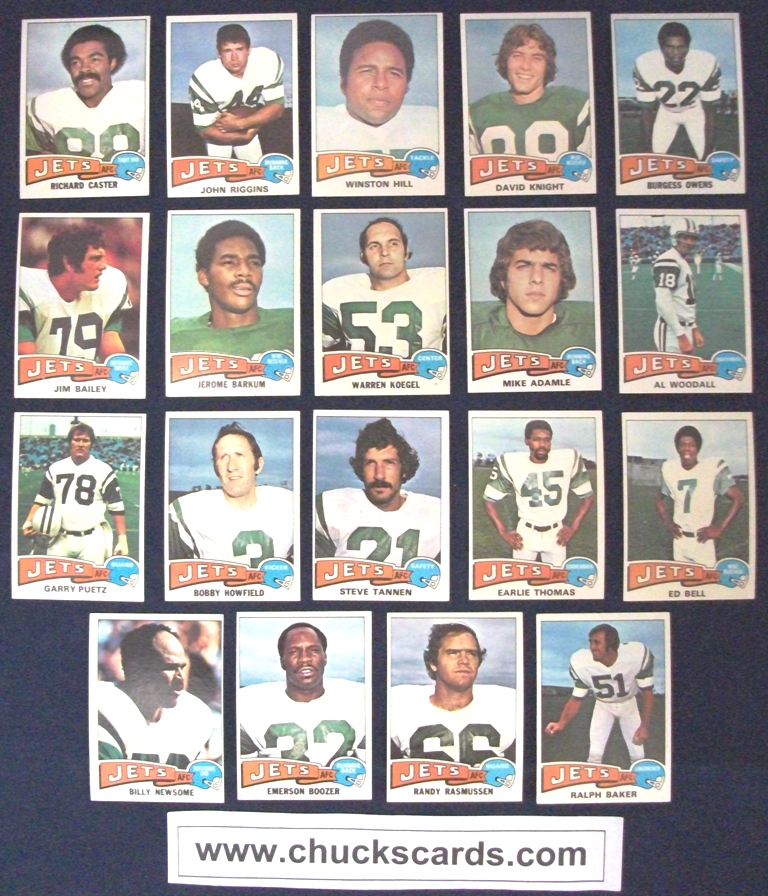
The 1975 Topps card of center Warren Koegel #53 immediately reminds me of a Presidential portrait, or even better, the famous painting of William Blake.  It's the image of a noble personage, a man looking hungrily beyond the the renderer's view.  Maybe that's the way he wanted it.  There weren't many "action" shots for that year's Topps cards.  Most of them were retreads from the years before or were reflective shots where the Jet players were asked to look off in the distance, and the players vacantly obliged.  Some have hands casually on both hips.  One or two try the lame, posed action shot - always amusing, for who are they defending against?  One or two look like they were taken during warm-ups at Foxboro the season before.  Among them all, Koegel's image looks like it belongs to a man who with a vision.  

His nickname was "Moose;" according to a rather detailed article on him for Coastal Carolina University in 2001 (where he was athletic director at the time), this nickname derives from the fact that he wore #14 as a Little Leaguer, the same number as "Moose" Skowron of the Yankees.  His Little League in Seaford, NY was very near the one I played for in North Merrick; what's incredible is that for someone as detail-oriented as I  (and about only a handful of things, mind you) I have no idea what numbers I wore in Little League, or even if I had a number at all.  That's bizarre.  It's another one for my mental health care professional.  

At any rate, Koegel (pronounced "ko-ghel," by the way) was director at Coastal Carolina and is apparently now in the same position at Jacksonville State.  Koegel was the offensive captain for Penn State in the late 60's and early 70's, with Jack Ham as defensive captain.  In the Coastal Carolina link above, there is an interesting detail about the end of Koegel's career in 1975.  He blew out his knee just before halftime in the away game against Kansas City, one of only three wins for the Jets that whole season.  His knee was repaired by Dr. James Nicholas, the eminent Merlin to Joe Namath's Arthur, the sports physician who enabled Joe to play longer than he could or should have.  "I haven't had any trouble with my knee since," Koegel says.  The irony is that Koegel's knee gave out before Joe's heavily braced ones did, which may be a testimony to Nicholas after all.  With the exception of John Riggins, the good doctor was sadly the most talented and able member of the team that year.

****
Out of Michigan State, drafted by the Jets in 2000, #53 Courtney Ledyard's KFFL profile through news releases looks like a journey back in immediate time.  In an instant, we know all the history we need to know, but nothing essential about the man - only the "transactions" of the quickly summarized past.  No looking through microfilm for us, or scrolling through the Reader's Guide to Periodical Literature, searching for "Ledyard, Courtney."  Those days are gone.  One link, one source.  That seems to be what it's all about.  At the above link, we begin with NFL Europe, where he was consigned in September 2001, and then to injuries earlier at the August 2001 camp, then his earlier re-signing in the spring of that year.  Such is Courtney Ledyard, whose name sounds like a band that toured with Lynard Skynard and Molly Hatchet.

****
Mike McKibben #53 arrived at Kent State two years after the shootings that marked the university in the historical mind.  What was it like then, and how did the jock culture at Kent State imagine itself in light of the countercultural community that the Troop G attacked?  How quickly did people need to move on there in order to move on with their lives?  Was it just a peripheral thing after a while, the way it is, probably, for students today?  People pass by the Prentice Hall parking lot to get to class and get on with their destiny.  


Mike McKibben graduated at a good time to join the Jets.  It would have been a good year for my Dad to join the team, and he was 41.  The jobs were available.  In 1979, McKibben's rookie year, the Jets broke even but could have done much better if not for the injuries that wore the team down to a nub.  Missing Pat Leahy alone cost them at least two games.  Mike McKibben became a starter very quickly, and it looks like he played at linebacker in all 16 games of that season.  He played less the year after that and then was out of the NFL.  He then played for Pittsburgh and then Denver in the USFL a year or two later.  Or vice versa.  

Oh c'mon, don't act like you remember their names right off the bat.  The Pittsburgh Maulers and the Denver Gold.  There you go.  There are no stupid questions here.  No one's judging you.  The interesting thing is that the Denver Gold practically replicated the Pittsburgh Steelers' uniform, while the Pittsburgh Maulers' purple logo looked like something out of the WPA.  Remember that the only stupid question is the one not asked.


"Ledyard, Courtney"