Showing posts with label New York Times. Show all posts

Sunday, October 23, 2016

NY Jets #70 - Part 5

The Jets won today. That's not a phrase I use lightly or, for that matter, often. They won in Jetsy fashion. Todd Bowles benched Ryan Fitzpatrick against the Ravens, started Geno Smith, who managed to get a touchdown pass to Quincy Enunwa before getting injured in the first half, perhaps badly. I don't know why the gods have such a thing about Geno. He is probably not a bad person, and he is, statistically speaking, not a talented enough quarterback for the gods to treat him with such feckless jealousy.

I have a former student who's now in the tenth grade, originally from Lithuania, who's a Jets fan. I don't know how it happened. I don't know what the basis was for his choice. Did he happen to catch one football game in his new country, a Jets game, sort of like the one the Jets played today - one where they benefited mostly from the opponents' miscues? Did he suddenly and misguidedly tell himself, That's my team? It's too late now, and he knows it. His loyalty is branded on his brain. Win or lose, he wears his Jets swag each Monday, but he's lately taken to walking into my classroom when I'm not teaching, and look at me with incredulity. Five times this year he's come to see me after five losses.

"Mr. Roche...," he says. Nothing else. He shakes his head.

"I know, kid," I say. "I know."

He says nothing.

"We're in for the long haul," I say encouragingly.

But he speaks frankly. "That doesn't help me."

"No. They'll probably win a Super Bowl in your lifetime, not in mine."

"That's even more depressing."

"Not for you, though," I try to salvage as we walks away. "Not for you!"

****
The blog is back. I don't know why. Why was this Sunday different from any other? Maybe I'm just avoiding the 90 freshman papers I need to grade. For a long time, I forgot my password to the blog, and I just let it slide. When I recently figured it out and returned, I found a handful of kind email messages from people wondering if I was okay, wondering when I would write again. I appreciate that. It's been almost two years since I last wrote, and some things in my life have really stabilized since then, while other things just keep me up at night. I'm probably just like you. It's been so long since I've written that I would visit the blog just to see if it was still there (why wouldn't be?) but after a fashion, the Google search for "Infinite Jets" would return with Did you mean Infinite Jest? No I did not, but never mind.

I did get a number of comments on past entries from family members and friends of players, some of whom had recently died. One guy wanted me to know that his mother was one of the original Jets cheerleaders from the late 1960's, and I managed to find some film I had somewhere of some of those gals cheering on the sideline and asked him if maybe one of them might have been his mom, who had passed away sometime earlier. He opened the link I sent him, on Easter, with all his family gathered, and indeed, one of the images was his mom. It was emotional moment, he told me. That was pretty cool.

I hope you're still out there. Hope you're doing better than our football team. I need to write more and at the very least finish number 70. There have been a lot of new players who've gone in and out of numbers that we already covered; I can't say I'll be able to backtrack and revise those entries. Maybe I'll try. Otherwise, I'll just keep moving forward by looking backward and hope that I'll serve you well. If you're reading this, thanks.

****

Between 1978 and 1984 there wasn't much to be concerned about. I was nine on the front end of those years, and 15 at the end. If he's lucky, a boy's life between those ages can be simply summed up as playing late outside with his friends until, to turn a Joycean phrase, his body glows, until it's too dark out to see the ball. When he goes home, there's a reliable meal on the table. When he needs to be somewhere, he rides his bike with abandon. When my dad came home from work at night, I hugged him, and his trench coat smelled of the city and of the train car's cigarette smoke. I was not always a happy kid, but most of the time there was nothing really outside of my own mind to make it unhappy. During the years I taught at a high school right outside West Philadelphia, I had already seen more than enough children who did not have the slightest glimpse of such a simple, contented life as the one I had known.

And then there was the Jets. In those years, they offered lots of promise, chances at what appeared to be greatness, but always, always in the end, an early exit. There are few things in life that I have loved with such unrepentant emotion as I did my football team between the ages of nine and 15. What else is there?

And so say the name Stan Waldemore #70, and I can immediately picture his face, his uniform. I can hear Marty Glickman or Spencer Ross naming him on the play. He didn't always start, though he started pretty regularly late in his career. He is a regular at retired player meet-ups. When I mentioned that I was writing about him, my wife noted that his last name is similar to the notorious villain of the Harry Potter novels. I think he replaced Randy Rasmussen, who was a Jet forever, a player who was invariably blocking in front of Matt Snell in all of the childhood stories I read about Super Bowl III. That must have been a bit of a challenge to follow after Randy Rasmussen.

He had a good career. This is about all I can say about him, though in his book The View from the Bench, former offensive lineman George Mills talks about losing his job on the Nebraska Cornhusker line to Waldemore when the latter was just a freshman in 1974. He makes sure we know that Stan Waldemore was a good guy. Mills had to constantly petition line coach Monte Kiffin that he was better than Waldemore, all the while acknowledging that injuries were prohibiting him from really competing with Waldemore. It was nothing personal, though. It was a career at stake, masking as a boy's game.

As for Dakota Dozier #70, our current wearer of the number, I do not see any record that he has started a game on the offensive line this season, but he might take comfort from Mills' book about being an unused football player, or perhaps he might be reminded that he is earning good money without having to worry as much about permanent brain damage as Sunday's starters will. As a former consensus All-American, that probably doesn't mean much to him.

****
Woods (at left) and teammates from Tennessee State University, before he was drafted by the Lions. I did not know I could want anything as much as I want the jacket worn by Alvin Coleman in the middle. At the right is Robert Woods, another future Jet, and Larry's brother.
Larry Woods #70 played for the 1973 Super Bowl champion Miami Dolphins and then signed with the Jets, playing for us from 1974-75. I do not remember seeing him play, but I remember his face among the player pictures in the game program. He has the distinction too of being a member of the original 1976 Seattle Seahawks. He started only three games for the Dolphins and was able to play considerably more for the Jets. In a Times article during the 1974 preseason, Woods admitted that the prospect of playing more often was more meaningful than being guaranteed a chance to go to the playoffs on the bench. By the end of the 1975 season, the year I first saw his face in the program, I was happy rooting for the Jets, so the experience was branded on me, even as they lost, over and over. By the time I was 16, like my Lithuanian immigrant student, out of the glow of an ordinary little boy's life, I realized I had made a terrible mistake. But it was too late.

Wednesday, May 21, 2014

NY Jets #69 - Part 1

Next week, AMC will be showing the last episode of the first half of Mad Men's final season. They're cutting it in half the way the network insisted Breaking Bad be done, and though Walter White's end was made even more suspenseful by halving his final season, I don't think it's as good for watching Don Draper make his final leap into the void. For one thing, the show has been in a perceived (though I would argue exaggerated in most people's descriptions) slump after season six, and it's just getting very, very good again in number seven. This feels cruel for those of us who have wanted to see Don and Peggy work out their demons together, as they did in last week's episode.

Don: I worry about a lot of things, but I don't worry about you.

Peggy: What do you have to worry about?

Don: That I've never done anything. And that I don't have anyone.

There you go. That's the show I remember. So I want it all, now. And I'll have to wait another year.

Season seven in both parts will probably run the span of 1969. We're somewhere in June, I think. Late June, maybe because someone is grateful at one point for the air conditioning in a hotel. Don talks about seeing his wife again in LA at the end of July, which he would have called "the end of month" if it had been July. There's also no discussion of an impending moon launch.

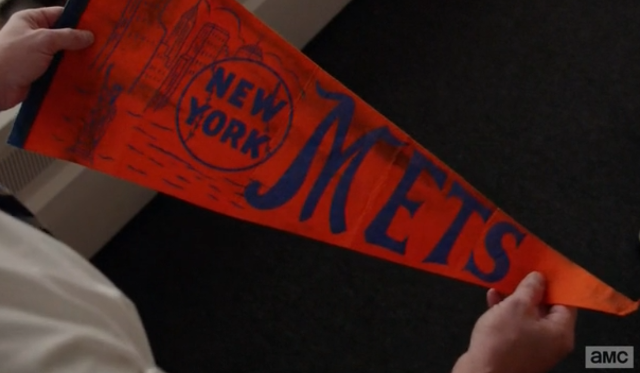
Baseball should be important to everybody sooner or later. For one thing, after finding the late Lane Pryce's old Mets pennant crumpled beneath the radiator in his new, smaller office, Don, in a drunken haze, invites the sober Freddy Rumsen out for a trip to Shea with him. In June 1969, the Mets are not yet the wunderkind of baseball. But if it's June, the Mets are beginning one of the most exciting climbs to the top that an organized ball club has ever known. They began the month with a nine game winning streak and finished it 19-9, still behind Chicago, but not for long. Maybe it's appropriate that Don - newly demoted to work for Peggy - identify with Lane's adopted baseball team, for the 1969 Mets were the "Miracle," which is what it will take to save Don in every respect before the end of the show.

It's also important because no matter what month of 1969 it is on Mad Men right now, the New York Jets are the champions of professional football in the United States. Sporting events get very little airplay on the show, which is why the Mets pennant (though definitely not official-looking) is so vital. Granted, Harry Crane came up with "Broadway Joe on Broadway," the TV special that gave Dow Chemical some commercial air time to make Americans think of something other than its napalm product being dropped on jungles in Vietnam, but Super Bowl III was simply mentioned on the show as "the Super Bowl," and not as a triumph for the home town football team. I was disappointed. How could I not be? Is Matt Weiner a Giants fan?

***

If two names could fit into the world of Madison Avenue 1969, it would be Sid Abramowitz and Harry Boatswain, both of whom wore #69 for the New York Jets. The number has two wearers who lasted a while in uniform, and four who were with us for barely a single year. Sid and Harry would be two of the latter. Abramowitz was drafted in the fifth round out of Air Force by the Baltimore Colts in 1983, and then later played for the Jets in 1985, a good season as Jets seasons go.

Harry Boatswain was born in Brooklyn, on June 26, 1969, maybe even during the very evening that Don and Peggy have that conversation above. He passed away in 2005. The single season he spent with us was 1996, the very worst season of the franchise's existence. Jere Longman quoted Boatswain at the end of an article in the Times about Jets players giving away presents at a community center at Christmas time, near the end of their 1-15 season. Longman suggests that it is a brief reprieve from a genuinely demoralizing season, but that even as they hand out footballs to kids, the players see looks of sympathy and pity for them. Why continue? wonders tight end Kyle Brady. Longman writes:

The players continue because they are professionals, and they are paid exorbitantly to play a game they have played since childhood. The season is lost, but there are smaller battles to win. A personal confrontation with an opponent. A contract for next season. Sometimes the rewards are simple gestures that were routine, even ignored, in the past.
''I got a letter from some kid in Africa who said I'm his inspiration,'' said offensive tackle Harry Boatswain. ''I don't know if it's true or not. Probably, my brother sent it to me to make me feel better.''

How Harry Boatswain became an inspiration to a child in Africa is indeed a mystery. He probably had reason to be suspicious, and he probably did have a good brother. Where that child from Africa, if he did exist, came from, and where he was going, leaves me with a sense of life's dislocations in time and in place. Seasons are lost, battles are waged, gestures that we make to one another as a means for making sense of it all come and go. There is always another year, apparently.

But life was too short for Harry Boatswain. His premature death came from a fatal heart attack apparently, while residing in Las Vegas. At the Stern Fan Network in 2005, three participants mention Boatswain's obituary in the Daily News. One says that "he lived out his Jet dream," possibly even speaking verbatim from the obit. Boatswain was a Brooklyn boy who, like me, was born in the year of his favorite team's only championship - only then to play for them in their worst year. Only the Jets could do that to a loyal fan. Only us.

Of course, as one other participant puts it, he died owning a Super Bowl ring, the one he earned while with the 1995 San Francisco 49ers, who might be rightly thought of as one of the best football squads ever. In his life's span, there was one professional ring, and the Jets, his favorite team, did not make it possible. Sure it's ironic, but hardly a consolation for someone dying so young. I just hope he felt like he had done more with himself, and felt the presence of more people in his life than Don Draper apparently does on a lonely night, somewhere near the beginning of Harry Boatswain's own brief existence.

Friday, August 2, 2013

George Sauer's Secret

Joseph Mitchell, author of Joe Gould's Secret
One of the great writers on my shelf is Joseph Mitchell, specifically his collection of nonfiction, Up in the Old Hotel. At first, I read him because my mother told me to, which is why I started reading everything I read as a boy. She was the first trusted librarian I ever had, and my teachers were sometimes frustrated to know that the stories that they recommended to me were not worth reading if Mom didn't like them. So naturally I read Joseph Mitchell. But his writing didn't come easily to me at first. To the modern reader, Mitchell is like an evening meal in Paris to an American tourist. The American notices that while he is scarfing it all down so that he can then move on to the next thing and then the next thing, everyone else around him is just savoring the time amid talk, bites, smoke and more talk, without ever checking their email or another's Facebook status.

In his short piece "Mr. Hunter's Grave," Mitchell writes,

"Invariably, for some reason I don't know and don't want to know, after I have spent an hour or so in one of these cemeteries, looking at gravestone designs and reading inscriptions and identifying wild flowers and scaring rabbits out of the weeds and reflecting on the end that awaits me and awaits us all, my spirits life, I become quite cheerful, and then I go for a long walk."

A lot of his work reads like that, and it requires re-reading because he begins and then stops and puts things parenthetically and stumbles into another idea, picks up the old one again and proceeds, while allowing us a little insight into the brittle nature of the narrator's sense of well-being, even as he becomes, as he says, quite cheerful.

Joe Gould
His most famous piece is Joe Gould's Secret, a work of greatness that is not so much a tale of a strange loner but is instead Mitchell's final study of the entire network of the city's "cranks and the misfits and the would-bes and never-wills and the God-knows-whats." Joe Gould is the greatest of those misfits that Mitchell loved to write about. He was a roaming, vagabond, half-genius, half-madman that all the artists of early 20th century Greenwich Village bohemia knew about; his nude portrait was done by the painter Alice Neel, who gave him three phalluses.

Joe Gould worked his whole life, from his graduation from Harvard, all the way through his days of wandering around New York, on the Oral History, a massive work-in-progress that was composed of tens of thousands of conversations from memory that he had documented through the years.

It's terrible to reveal endings, so I won't too much. But Joe Gould did have a secret, and suffice to say that his secret was, in some ways, that he had no secret at all. 

I felt like mentioning him a few weeks back when I wrote about former Jets wide receiver George Sauer, who died in June from heart failure after struggling with Alzheimer's, but I didn't want to presume so much as to connect the hypergraphic Gould with Sauer's searching soul. But while I was away on vacation recently, my mother sent me a clipping of Jack Williams' article in the Times about George Sauer's legacy of unfinished writing. Mom didn't send me the link to the article, as I do here, but she still lives in a world where a person cuts out an article out of a paper newspaper and sends it through the US mail to another person who receives it a few days later. Sometimes I miss that more patient and gradual world.

George Sauer, who quit the Jets and football altogether in 1970 after posting consistently great seasons at wide receiver, became in early retirement a full-time writer, a profession that must have seemed infinitely exciting to a still young man who, at a time of growing individual freedom of expression, felt that he needed to tell his story. I'm so grateful for Williams' work in tracking down the truth of George Sauer's mysteries, though like many real-life riddles, the story is more sad than engaging. In his effort to spend the rest of his life trying to write the story about his life, the life of a football player, the secrets of things he had discovered in the world, the strange odyssey of his experiences growing up the son of a football star himself, he managed to complete very little of the actual novel he wanted to write:

"By the late 1990s, George Sauer Jr. was living in Sioux Falls, S.D., working at the Sunshine Food Stores stacking shelves by day and writing his novel by night.
"'George would talk about how he would go home and write, but, you know what, I would never see any of his writing,' said Mike Dhaemers, 55, who was Sauer’s supervisor. Dhaemers remembered him as being friendly, intelligent and interesting, but a private person. He was so private that he worked in the store for more than a year before anyone there discovered he was a former football player."
A co-worker at the store is quoted as saying, 

“'He was, without a doubt, the most intelligent and talented man I’ve ever known,' Knutson said. “'He knew and understood things from medicine and nuclear physics to classical and popular music to Saturday morning cartoons and ’50s and ’60s TV sitcoms. He was Curious George in the flesh.'”

Yet the work never materialized, nor did a single sense of place for George Sauer. He married four times and apparently struggled through life in trying to find a place to feel at home. One of his ex-wives is quoted as saying that he never saw his life as anything else but as a novelist, while adding that Sauer "had problems I couldn't solve." 

When I saw George Sauer interviewed, talking about his unfinished novel at the tail end of the DVD that accompanies the Namath NFL biography, I thought instantly about Joe Gould. There's some part of us that seems to always know that when a person has a lofty ambition we know that the enterprise will not come to be. Joseph Mitchell had enough interest in Joe Gould's Oral History to believe in its authenticity and that it would come into being someday, but what he encountered in Joe Gould were problems that he too could not understand or even solve, though Mitchell did try. What's more, having come to understand Joe Gould's actual secret, Joseph Mitchell published his last profile of him in 1964, but then never published a single story ever again before his death in 1996. He himself contracted writer's block, one almost seems to think by mere proximity to his subject. 

Still, part of me also believed that someday I would read George Sauer's book and that I would be drawn into the interior world of this mysterious figure who was my first football hero. I knew though from experience how difficult it is to write anything worth reading, not because no one will think it worth the time, but because the tale to tell is never quite the right fit from the thought to the page. Writing gives us life lessons, regardless of whether or not it is written with that intention, and so we feel there's a deep responsibility in the act. Writing reveals aspects of life that the eye, ear and our conversation cannot.

But not everything can be written as it seems it be in the mind. Life remains a constant mystery, as it has been to everyone before us and everyone to come. So the story goes unfinished for now, but it will be written someday, because it must be written someday, because all the works published in the world happen to get done somehow. You know in your heart you have what Whitman calls a verse to contribute to the powerful play of life, and it will get done someday. And maybe it will. But often, it does not.

The worst part is that Sauer was in a race against time. According to Williams, Alzheimer's ran in Sauer's family; it killed his father, and it was eventually responsible for his own death, so perhaps many of the assumptions - mine own, included - about football's role in his demise were just that. (It seems cheap and easy to reprint the piece of poetry Sauer wrote about living with the legacy of a disease that kills your mind, but read the little piece at the link to Williams' story about his father that describes how "his broken brain rattles mine.")

Namath and Sauer, in glasses
Last month when I wrote about George Sauer, I mentioned the photograph of him shaking hands with Willie Brown after a hard-fought contest on a bitter cold day in the AFL Championship of 1968. This time, I look at the photo at right, from the Times that accompanied Jack Williams' article, and I see something else. It's apparently "three weeks" before Super Bowl III, and there's Namath, sitting next to his indispensible wide receiver. Sauer wears what looks like thick glasses, looking not at all like a football player. 

It's easy to read into a picture things that don't exist at all; we describe the story that we think we see. So it looks to me like Namath wears his usual sheepish expression, while Sauer stares off into something else. Maybe they're looking at film. Maybe they're listening to Weeb. You wonder what is going through Sauer's mind, as the Jets prepare for the franchise's greatest adventure. Perhaps Sauer is preparing for his own, knowing that a win will not only secure the Super Bowl, but also his freedom from playing the game he's been obligated to play out of tradition and respect for his father. It's a game that currently stands in the way of his dreams of being himself and of telling the tales he needs to tell. But I'm probably imagining things. The picture is just that, and maybe that's enough. But it's impossible not to try to write the untold stories, even if one risks encountering the possibility that those stories will never get written. The thing is to try, as George Sauer did.

Monday, September 20, 2010

And Here I Re-Publish the NY Times: "Jets In Certain Loss Until the Second Half"

by Vince Graylady, Sports Columnist for the New York Times

The unkempt hordes were treated to something akin to a complete victory when the Jets beat the New England Patriots Sunday 28-14. There were smiles of relief on the faces on fans departing the stadium Jets fans are compelled to share with New York's older, more storied franchise. But Serious Questions regarding the injuries to Darrelle Revis, Nick Mangold, Jason Taylor remain, as do concerns over the very existence of a team that a better class of New Yorkers regard as one would the development of a neck goiter.

The New York Jets were very nearly the same team that lost to the Baltimore Ravens last week - unimaginative, incoherent, bloated, loutish, confused, disoriented, and profane - yet somehow, through the mystical works of a universe guided by what appeared to be chance, the defense continued its relentless pressure against Tom Brady in almost the same way that the better-known New York franchise did two Super Bowls ago. Whether or not the Jets' defense would have been distracted by the presence of either of the women with whom Brady has produced children is uncertain. The verdict still remains on the attention span of such a Jets team, and thankfully Bill Belichick presented his detested rival with merely the Patriots' expected lineup. In this sense, one cannot entirely see the Jets' two-touchdown win as a complete victory over a vastly superior Patriots club.

Randy Moss scored his 150th touchdown, a stellar catch made with one hand - gesture that seemed destined to rank among the best of his Hall of Fame career. Meanwhile, the Jets did some things right. They completed passes, their offseason acquisition gained 76 yards on the ground, and the secondary appeared to be in the right places at the right times. That the Patriots did not score the entire second half signified that either the Patriots were doing poorly or that the Jets did well. Jets fans - corpulent, uneducated and rough - may have regarded it as a victory. Less partisan onlookers were prone to scratch it up to an unfortunate stroke of good fortune.

"When Moss got behind Revis to make a one-handed catch for a 34-yard touchdown," wrote George Vescey of this same publication, "the Jets had seemed to be in big trouble in their new home, with their own glib words coming back to haunt them." But even Vescey was forced to agree that the Jets had the game in hand by the fourth quarter. And to do it, "they didn’t need the reality-show language and bluster they exhibited on the television show Hard Knocks....The Jets did not need to make a spectacle of themselves, either on television or in their own locker room," he added, shaking his head in disappointment at the Jets' apparent victory.

The behavior of their coach, their assistants, and players in the presence of Ines Sainz continues to haunt the team. Even avid fans like Martin Roche, whose Jets blog has changed names too many times for the Times to count, has spoken out against the organized harassment of Sainz: "This is the kind of thing that makes me wonder why football itself is of more importance to me than issues of sanitation in the Third World."

The Times spends a great deal on its football coverage itself when its award-winning columnist Nicholas Kristoff is practically earning a Nobel Prize for Peace, and it makes the men who cover the Jets feel a crisp sense of shame that a good showing over the Patriots cannot help quell. In fact, Jets victories only seem to make it worse. The question is not so much whether or not the Jets can sustain their success without Darrelle Revis (a question they were wondering during training camp anyway) but whether or not the success the Jets have will force to compel a reader of the Times to imagine the distinctly unpleasant possibility witnessing a victory parade down Broadway filled with heavy men in Broadway Joe shirts.

Fortunately history tells us that the Jets won't get that far. Nevertheless, Times sources inside the Bloomberg government indicate that the current state of the city's economy would prohibit such a celebration.

Unless, of course, the Yankees repeat.

Tuesday, March 30, 2010

NY Jets #43 - Part 1

On April 23, 2005, Mike Brim #43, who played cornerback for the Jets from 1991-92, was murdered by another man outside his home in Virginia. At present, the only thing I can find about his death is that it was the result of an "argument over a woman." When people die young, there is always a question of a suicide, an overdose, an accident, or a murder. His violent death is familiar considering how many athletes who, through their own fault or someone else's, go well before their time. Last year Steve McNair was killed by a woman, while Mike Brim was killed "over a woman," reminding us once again that a crime of passion is more likely to involve a mere injury any other society where owning a gun is not perceived to be an inalienable right endowed by one's creator. I was shaken by McNair's murder last year, but the event has already entered into our consciousness as just another unfortunate event with nothing to do with our society's pathological love of bearing arms. It enters into our minds with the same bland acceptance as massacres at schools.

The above link from Bassett, and the comment that follow, both speak of Mike Brim's fine play. His best years were as a Jet; other than a Jet lifer, who else can we say that about that we've looked at so far? His best season was 1992, especially with a touchdown (on one of his six interceptions that season) against his former team, the Detroit Lions. His career from 1988 to 1995, with five different teams, seems parabolic. Football is not like life; in life, moments of joy may be sparse, but they're distributed over a broader spectrum than a football career provides. For a football player, life is Hobbesian - nasty, brutish and short. Joy is always a peak on the graph.

****

Why do I read the marriage announcements in the New York Times in the Sunday Styles section? Even I don't know. Who do I think I am, some kind of old Dutch family squire? And what am I looking for? I saw one person that I graduated high school with who ended up there about fifteen years ago, but that's it. It's a Sunday habit. I also go copiously through my college bulletins to see what's happening to the people of my graduating classes (there's not much, actually). I've stopped looking to see who's gotten married, and now I'm on to seeing who's having their third kid. I have two ex-girlfriends who are published writers, so I'm always curious to read about their exploits even though I have no intention of contacting them. I do not imagine that I will end up in anything they write. Which is good, believe me.

But pretty soon I'll be looking there to see who's died. I'll become one of those people who look at the obituaries every day. We're all just perennial browsers, making note of all the recorded ceremonies of birth, school, work and death - marking time in the family of humanity.

The only trouble is my family and my friends are spread out in many places, and there's very little sense of community that I have with anyone out there, largely due to my own introversion. I am a quintessential kind of American, a lone soul successfully disconnected from the points of community, who's actually not as self-reliant as he'd like to believe. I shop at all the same stores as everyone else. I eat the same food as you. I watch TV when I could read, and when I read, I read things that you're probably reading. I drive when I should walk. With the exception that I refuse to do Facebook, I am principally average.

John Dockery
On Valentine's Day this past year, I saw in the Styles section the notice for the marriage of a Ryan Kaple and Ciara Dockery, and I wondered aloud, "I wonder if that's John Dockery's daughter?" And by God, it was. If you watched a football game between the late 1980's and the 1990's, it's very likely that you saw John Dockery #43 on the sideline of a college football game, usually reporting for CBS or NBC . But John Dockery was also part of the crew that ran around with Joe Namath back in the day and played cornerback for us from 1968-71. I believe he still reports from the sidelines for Westwood One on Monday Nights.

Dockery graduated from Harvard and was on his way to studying Urban Planning at Columbia, according to the Jets' 1971 Yearbook. But clearly he had a view that football glamor led at least to some speaking parts on the margins, so that career in building things fell aside. He had a big season with the Jets in 1969, with a team-high five interceptions and had a single shot at playing both ways with one rushing attempt for seven yards in a loss against Denver. It must have been a great time to be a Jet, waltzing into Bachelor's III with the man himself. When Dockery started doing TV with Bill Mazer (on Channel 5?) in New York when I was little, I remember my parents independently pointing him out to me as a relic of a Jets' past that I had just missed. It was sometimes hard to imagine someone as a Jet if he wasn't standing right there, in front of you, in the green and white. I was jealous of their memories of a time when the Jets were good, when life was good for the Jets and John Dockery's name was called at games. If the Jake Gyllenhaal biopic of Namath ever happens - and I'm starting to doubt it will - then who will play John Dockery? He and the man himself currently run a football camp that shares their name. All things total, it has not been a bad life for John.

So when I saw his daughter's marriage listed, I reacted as the perpetual loner living in his imaginary village, half-heartedly search for community. I thought, How great for John Dockery. I'm happy for him. What an auspicious match! I wonder why I wasn't invited. This is why being a fan is an essential part of being a human being. Simply by assigning our loyalty to a club, we are suddenly a member of a community that can exist to whatever degree we like within our imagination. As if being a Jets fan is, in some ways, a network of belonging that defies logic, opening doors to belonging the way that being an actual Jet did for John Dockery. If it hadn't, then perhaps he would have been an architect.

Thursday, March 18, 2010

NY Jets #42 - Part 3

I was in Memphis, visiting my parents when I saw the news that Ronnie Lott #42 was joining the New York Jets. This would be summer of 1993, after my horrific first year of graduate school that saw at least one major anxiety attack and certainly one nervous breakdown. Some things just look like good decisions from the start, and even though most of my professors thought I was wholly unprepared to do what I was trying to do, I was deluded into thinking they were wrong. I'm not sure that has anything to do with Ronnie Lott, but I was similarly deluded into thinking that when we signed Lott, Leonard Marshall and Art Monk, the Jets were trying to do something that other people thought they couldn't either, like make the playoffs.

And it didn't work out. Neither did grad school. Well, that's not entirely true; I got my degree, so technically it worked out. The Jets? Not so much. That's been the story of my life, I suppose. My life has more or less worked out so far, though I've spent an awful lot of time unconsciously wishing for my team's success, even to the point of half-willing away my own happiness. As the poet says, "May no fate willfully misunderstand me/And half grant what I wish and snatch me away/Not to return. Earth's the right place for love."

Anyway, instead of being like the 1990 San Francisco 49ers, the Jets ended up looking more like the 1962 New York Mets, gathering future Hall of Famers - and NFL All-Time Team members, I think - like Monk and Lott who were at the tail end of their efficacy. As I recall, upon being signed, Lott said something to the effect that he hoped other talented NFL players would take the offers of the Jets' free agency cash. Ah, I always liked Ronnie Lott. Maybe he thought the Jets would make the playoffs in 1993. But younger, talented players around the league demurred. He pulled an average year in 1993 and started 15 games in 1994, a legendary season among Jets' collapses. Duke Snider is in the Hall of Fame as a Dodger, Richie Ashburn as a Phillie, neither of course as a Met, despite (or because of) their sporadic appearances in the 1962 lineup. Lott is in Canton as a Niner. Monk is there as a Redskin.

****

There was once a time when the New York Times allowed you to read any of their articles online for free so long as you were a member. Obviously those days are over, and I half convinced myself that a downloading binge I went on two years ago was responsible. "There's some idiot in Philadelphia who's pulling up every article on the New York Jets' seasons in the 1970's, and we're not seeing anything in return!" Obviously that's not the case, but I'm a serious person. When I was 13 and apparently friendless, or at least certainly without the possibility of anything resembling a girlfriend, I spent most of my free time in my high school library, trolling through spool after spool of Time magazine on microfilm, reading back issues going back at least 20 years. It was as if I had returned to consciousness after a two-decades long coma, trying to find out about all I had missed. More likely I was what I was - a baffled child in the Reagan years of nationalist sleepwalking when all the country was ignoring the wake of cultural revolutions that were making it seasick. I'm not sure Time really helped clarify all that, but, again, I was 13. And there was no Interwebs.

Anyway, I just paid the New York Times $4.50 to double-check some information on Cliff McClain #42, Jets' running back from 1970-73. Maybe it's an extravagance when for the same amount of money I can buy myself an afternoon's on-street parking in Center City Philadelphia, sure, but bear with me. Cliff McClain might have been part of a moment that could have changed the course of professional football history. As with anything else, it all rests with the little things.

Cliff McClain
You see him here in a small photo courtesy of WireImage against the Cincinnati Bengals in the last game of the 1971 season. The Jets won it, 35-21, but more importantly, Cliff McClain scored one of his two career touchdowns in it, a 63-yard run. I suppose this was his highlight as a pro. Otherwise, Cliff McClain had a fairly ordinary football career; at the risk of offending the subject himself, one might even go so far as to say his career was not particularly successful and that he probably saw little play time. He gained around 400 yards over four seasons, and he retired a Jet.

On November 19, 1972, the Jets traveled to the Orange Bowl to play the undefeated Miami Dolphins. By this time the Jets were 6-3 while the Dolphins needed only one more win to clinch the AFC East. The Jets had been a split-personality team in 1972 - a "jittery" one, as Sports Illustrated called them. The truth is that they were almost a good team, certainly not a great one, playing what most people believe (not me) was the greatest team of them all. And by the start of the fourth quarter, the Jets were winning, 24-21. One of the hallmarks of the Dolphins that season is that when they went down, they always came back, and they did come back and win that game, 28-24, clinching it on a Mercury Morris touchdown. No surprise.

No surprise either also that the Morris touchdown was enabled by a Jets turnover in Miami territory, in this case, on what is reported to be a muffed handoff between Namath and Cliff McClain with the Jets ahead. It's the little things. We are free to place blame all around if we like. I'm sure there are ways of finding out what happened, but it's true that this particular turnover midway through the fourth was the start of what eventually sent the Jets to the showers. Instead of placing blame, let us suggest instead that Cliff McClain was simply witness to a piece of history, a crucial turning point. Once the Dolphins rallied, they would then go on to win every remaining game of the season handily and saunter into the playoffs. The Jets were their last real challenge before the postseason.

Now, imagine if the handoff had actually gone well, and then a variety of almost reasonably fortunate circumstances eventually led to a remotely possible Jets score - let's say, even another Namath touchdown pass, maybe to Rich Caster or Don Maynard. I know this is unlikely, but work with me. History is filled with options and possibilities that, reason tells us, could have happened. It is the responsibility of historians to find those turning points in history and see how much really rests on them. It's also the responsibility of a loyal fan of a traditionally losing franchise to waste countless hours of his thought conjuring all such similar moments, especially when such things provide an assurance that it's not just Fate, but luck - and bad luck, of course - that has traditionally kept your club from its appointment in your lifetime with destiny.

Thus, a Jets touchdown later in the game would have meant that the Dolphins would have had to have mounted an even greater comeback- which, in all likelihood, they would have - in order to win. According to what I know, there was enough time.

But imagine if they hadn't succeeded. The possibility is remote, I grant you. The Dolphins' third touchdown earlier in the game is indicative of how remote it would have been. This was scored by Earl Morrall, on a 31-yard bootleg. Morrall was 38 years old by that point, which means he was older than the number of yards he scampered on the play. According to Al Harvin's article in the Times the following day, Morrall said, "I think that must the longest run of my career," adding, "I think I ran 25 yards in college once." If Earl Morrall could find that kind of hole, how much more would the Jets have given up to a rallying Miami offense late in the game? So again, I grant you.

But consider the possibility of Cliff McClain not fumbling and suddenly you are taken down one circuitous route of conjecture after another: the Jets might have held on to win at the Orange Bowl, and then the 1972 Miami Dolphins would today be simply regarded as a great team but second to the 1985 Chicago Bears (whom I feel reign supreme) as the greatest ever, and they would never have held the one true record that has eluded the Patriots and the Colts in our era - that of complete perfection from September to February. The mind reels. Just as in high school, the mind evidently has nothing better to do.

Monday, January 18, 2010

Always fascinating to see how the printed media (albeit online) in New York covers the Jets.

The Jets are traditionally a kind of muse for Newsday, the paper whose beat is the sprawl of the Island so many Jets fans historically call home. On page one, you will find a thoughtful piece on what Dr. King would say to President Obama, as well as a nice juicy slab of business about a young couple passed out in the middle of day (near the start of the Saints game, no less) in Suffolk County while their 3 year-old wandered the streets of Brentwood. Newsday has always walked the fine line; I recall delivering them for a neighbor while he was on vacation during the summer they finally apprehended Son of Sam, though I'm not sure I was savvy enough to notice their high- and lowbrow takes on the matter. At the top of the page, though, is a banner with the essential information about what you really want to know about: Jets vs. Colts. We know what you want.

The Times remains staid about it. There's too much going on in the world. Of course, the Old Gray Lady is correct, as she always is (well, except about initally supporting the Iraq War; oh, and about calling for Clinton's resignation; and oh, well, its plagiarism cases). My beloved team cannot compare with the catastrophe of Haiti, nor with the suicide bombings in Kabul. (By the way, a student last week tried speaking for Pat Robertson's sickeningly stupid claim about the quake being God's will; I wish that I had known that it was actually the Enriquillo-Plantain Garden Fault that runs parallel to Port-au-Prince that caused it, as I would have told her, although she certainly would have claimed that God put that fault there. God can do anything.) However, I was grateful that the Lady was kind enough to make the Jets the top story in the Sports section way down the page, especially when the Jets' win over Cincinnati last week fell second to the NFC playoff game that same day.

The Daily News puts the Jets atop their "Hot Topics," right ahead of the Golden Globes and the earthquake, which posts an impressive third place.

The Post puts the Jets first and foremost, while secondly speaking of machete-wielding gangs roaming Port-au-Prince. It claims that NYPD have also been silencing Duane Reade security guards in the Port Authority over reporting an increase in thefts, while they do their able best in the service of Rupert Murdoch by criticizing Governor Paterson for going out on a date.