Thursday, November 11, 2010

NY Jets #45 - Part 4

It's hard to walk around with a name that everyone either associates with the most dread of household inspects or with a joint that has gone nearly past its usability among many hands and mouths. But like most of the blemishes of one's life, you get used to it, especially past the age of 12, when most kids are done pestering you about the obvious things that make a person ugly - your face, your walk, your voice, your name. Then you enter the adult world, where it's different. Grown people make quiet note of the blemishes God gave you, without needing to turn it into a soul-shattering verbal refrain that, as a child, you'd have to steel yourself for on the lunch line, day in and damned day out. Adults save such cruelties for their own private amusements, waiting for just the right moment to bat you back into mortal place.

I'd still rather be an adult. If today someone makes a reference to how I must get high a lot, or to Franz Kafka, or to being the only one who will be able to survive a nuclear attack, I can always say, "Oh. Yeah. Right. God. I've never heard that before."

But what about Tony Stargell, who played in #45 for the Jets from 1990-91? When I was a little boy in Pleasantville, NY, and Tony was 13 and growing up playing football in LaGrange, Georgia, Willie Stargell shared SI's Sportsman of the Year with Terry Bradshaw.

Willie Stargell
(1940-2001)
Willie Stargell was "Pops," the most recognizable baseball player of his day outside of Reggie Jackson and a fine example of a human athlete as well. Willie Stargell's power so obviously came from a frame unenhanced by performance enhancement, that in his near middle age he had a beer-gut. He preferred a good time to a statistical high, and he still won the NL MVP in 1979 at the ripe old age of 39.

I was a Mets fan, but I rooted for the Pirates in the 1979 World Series because they were National League, because they were the underdog, and because they were "Family," with Pops at the head of the table. Grown men of Tony Stargell's age still know who Pops was; he was larger-than-life, but he is gone now, long dead and gone by more years than I can believe. It seems like only yesterday that I was imitating Wilver Stargell's batting stance in my cousin's backyard, trying to capture his strange lilting action of the bat as readied for a pitch. Men of a certain age - my age and Tony Stargell's - know who Pops was. He was exactly the model of what sports isn't now. Sports is not really about fun, and to paraphrase an axiom of Wilver himself, the man yells play ball, not work ball. He doesn't yell "moneyball," either.

It seems awfully trite to say something like that nowadays, but the shift in priorities is infectious throughout our culture. The pay scale for baseball players is based on their statistics. The man who was recently elected to become the new governor of the Pennsylvania Commonwealth is imitating the fat man who governs New Jersey in the belief that public school teacher pay should be linked with the statistical data of student testing. Nothing can remove the love of learning any more than moneyball can ruin a love for baseball; people will still be taught by creative-minded teachers and will also still be watching baseball when these narrow-minded governors are dead and forgotten, save for being mere names on occasional bits of state park property. But both teaching and baseball are a whole lot less fun when they're purely the property of statistical content. And since moneyball became the way of America's Game, Willie Stargell's Pirates haven't been to the postseason, either. His statue stands a lot larger outside their park than Willie Stargell himself once stood, but for men of a certain age - mine and Tony's - that's pretty damned tall.
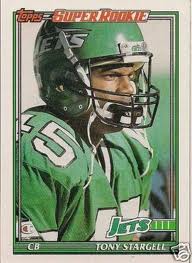
Tony Stargell
(no apparent relation)
Why must I go on like this? The truth is I actually don't have much to say. Tony Stargell started his career with the New York Jets at defensive back after being drafted by them in 1990. The Jets could have taken Ricky Proehl; they could have taken Neil O'Donnell, Bobby Houston or Anthony Pleasant (all of whom would go on to play for us eventually, anyway); more importantly, they could have taken Larry Centers or maybe even Fred Barnett, though lots of Eagles fans might argue otherwise. Tony Stargell was picked out of Tennessee State and played two seasons with us before going west to Indianapolis. Linebackers stay a while, receivers are needed even when they're not wanted, but the secondary seems so expendable. Tony Stargell is another name gone in and out of our franchise's defensive backfield, and his statistics make no more than a ripple than those belonging to Torin Dorn or Le-Lo Lang, both of whom were also drafted by as defensive backs NFL teams in 1990.

Torin Dorn's a funny name when you say it (didn't his parents say it to themselves beforehand?), though obviously Le-Lo takes the cake. Many men must carry such burdens, and they grow up and out of them. But Tony Stargell probably had to carry the burden of being perpetually asked if he was related to Pops, and when you're an athlete being compared to a legend with your name, you inevitably fall short, regardless of whether or not people understand that you're not related. And no, Tony Stargell was apparently not related to Willie. All of us make mistakes, but when Tony Stargell did for the Jets, the Colts, the Bucs, the Chiefs and the Bears, some smartass in the crowd, on the sidelines or even in zebras probably uttered the phrase, "Sonuvabitch should have stuck to baseball." And that's not fair.

****
Corky Tharp #45 is far right.
Thomas "Corky" Tharp was drafted by the LA Rams in 1955 after having a stellar career rushing at the University of Alabama. Five years later, he shows up wearing #45 as defensive back, playing most of the 1960 season for the New York Titans before retiring that year. Above, courtesy of Corbis, you see him in action, to the right, trying to tackle Houston Oilers rookie Billy Cannon. Corky's ride in football, which took him from Alabama to Canada with the Argonauts of Toronto and finally the Titans, is about to come to an end. Billy Cannon's ride in pro football will last another decade, during which he will be turned into an unused tight end for the Raiders and the Chiefs. In the image above, Corky seems already to be shying away from Cannon and the life that football has provided. It's fading time. It will come for Billy, too.

And if you can't tell it from that picture, try the two images below, a before and after. The one on the left is Corky Tharp, the young student who gained just over 2,000 career yards for the Crimson Tide, staring off into a seemingly limitless horizon. The second looks more like After - the smirking, knowing expression of an experienced grown man who has been converted several times over to the most dispensable of positions, playing on an AFL team that can barely break even.
Corky (before)
Corky (after)


Finally, we come to Earlie Thomas, #45 for the Jets from 1970 to 1974. Did he also start his career in the Canadian pipeline? It's an interesting question because apparently his NFL career began with the Jets at the age of 25.

On a humid day at Harvard Stadium in 1970, Earlie Thomas, a rookie out of Colorado State, intercepted a pass by Mike Taliaferro and ran it back for a 36-yard touchdown, giving the Jets a 28-7 third quarter lead. As they have been wont to do in my history with them, the Jets nearly gave away what was left of the game, managing to hold onto a 31-21 win. I find it interesting, by the way, that in 1968 the Patriots played at Fenway but then at Boston College's Alumni Stadium in 1969, and then at Harvard a year later. After that, they became the New England Patriots of Foxboro that we all know and love so well.
Master's or PhD?

Earlie Thomas' interception was just a little more than enough to keep Namath's offense ahead (Joe went 9-for-20 that day). It was am early start to his career; some men are aptly named after all.  Earlie never ran one back again in his entire career. He would pick one more off that season and make four more interceptions his remaining career, ending up in Denver in 1975. Some things come early to those who wait, but then are gone for good.
Some information on him from the 1974 Jets yearbook, apparently Earlie Thomas earned his Master's degree in something related to agriculture, for his dissertation (which speaks to a PhD) "ison aweevil parasite" (sic). At least he's doing some good somewhere, one presumes.

Saturday, November 6, 2010

NY Jets #45 - Part 3

First, running back Eddie Hunter #45 may not have been a replacement player, even though he only played one season with the Jets, in the strike year of 1987. He scored two touchdowns that year, but I may have been too drunk or boring at college to have even known about it at the time. All that can be gleaned from the record is that he had a two-year NFL career with the Jets and then the Bucs. Both his touchdowns came on passing plays in his rookie year.

****

Speaking of the undergraduate, there are players who operate in the collegiate world like gods - men who are legends to a population at the height of their capacity for enthusiasm. Such is the college star. And the person who makes the best cult recruit is also the biggest and loudest fan in the stands - the college student. I remember having an irrational, deep, cosmic attachment to my college's basketball team while I was there, and I don't even like basketball all that much. I remember seeing our star point guard at a college party and being introduced to him by friends as simply "Money." Something tingled at the base of my neck when I clasped his hand. I remember screaming my lungs out when they won the tournament championship about three years after I graduated from college. Was it the truest happiness a person could feel? I nearly had a mental collapse when my alma mater went into triple overtime in the Elite 8 of the NCAA tournament 12 years ago. Following college sports prepares you for one thing and one thing only - to be a Moonie.

But what eventually happens to these immortal college stars, these cult idols? Tim Tebow scored his first professional touchdown against the Jets, but will he ever be any more than just another star made humble by the unsentimental world of crass professionalism? If the Christian Coalition has anything to do with it, then he will absolutely run for Governor of Florida someday. But think of John Huarte, Pat Sullivan, Brian Dowling, Ed Marinaro (we'll get to him), John Rogan, Pete Beban, Billy Cannon or Gavin Grey. Sure, Tebow can run for President, but what has happened to the rest?

Iacavazzi in a Princeton
Jets uniform
What ever happened to Cosmo Iacavazzi? He graduated from the last undefeated Princeton team in 1964 and was eventually drafted by the Jets for the 1965 season. In the crucial final game of the season against Yale, tied at halftime (Princeton had never been down all season) Iacavazzi then went on score on runs of 39 and 45 yards in the second half. At the moment when his team needed him most, he came through, as the great ones always do. He must have appeared to the Princeton loyal as the most blessed human on Earth, and Princeton ran away with the Ivy Title. He was a runner-up to John Huarte for the Heisman, well ahead of Joe Namath. The Jets then got all three of those guys that year - Iacavazzi, Huarte, and Namath. Huarte never took a snap. Namath changed the course of American sports, and Cosmo Iacavazzi is said to have suited up for two games, without any note of yardage gained.

He must have been thought of as something special by the good people of Topps because here is a 1965 rookie football card as a Jet. He's clearly still wearing his #32 Princeton jersey with the tell-tale Tiger-striped sleeves which have been rendered by the artist into the Jets' green and white. Unlike Tim Tebow, Cosmo Iacavazzi was given a new number as a pro - in this case #45 - with the Jets, starring as nothing more than a backup. The card reveals him metaphorically and literally. He runs toward us out of that unpleasantly yellow background of 1965 Topps, colored a Jet, yet still frozen in his Princeton life.

As the link above shows, he has lived a life of restless pursuits since graduation, including being the mayor of Hillsborough, NJ. That's better than being an orthodontist/forger like Billy Cannon. But is any kind of life good enough for a man who has been the most recognized person on campus?


Jets
Patriots
Jets
Patriots


Speaking of a restless life, what about Otis Smith's, in #45? He is one of my all-time favorites. Otis Smith began his career as rookie free agent with the Philadelphia Eagles at the ripe old age of 26 in 1991. He wore #30 when he began with the Eagles and #23 for the Lions when he retired. Above is a display courtesy of pro-football reference.com, which takes the time to show the numbers that a player wears and also how his uniform evolves, whether playing for one team or for dozens over time. In between the beginning and the end of his career, Smith wore the #45's you see above. From left to right they represent the Jets, the Patriots, the Jets, and then the Patriots again, all between 1995-2002.

The green 45 with the black outline represents the years of Richie Kotite's reign of error, but then Smith was traded mid-season 1996 to Bill Parcells' Super Bowl-bound Patriots, who are represented by the light blue and red 45. The green-outlined 45 represents the point at which Parcells took Otis Smith with him back to the Jets.

The last 45 on the right is for the dark blue and red Patriots of Bill Belichick, who took himself, Otis Smith, and much of my desire to live with him back to Foxboro. It was during Smith's second Super Bowl in New Orleans with the Patriots that he made the most crucial play of the organization's history. Adam Vinatieri's field goal to beat the Rams in the Super Bowl was set up by Otis Smith's interception of a Kurt Warner pass.

Otis in the right place during the
1999 AFC Divisional Playoffs
Otis Smith blew a lot of coverages for the Jets. Somehow I remember that. But he made big plays - I know that, too. I don't recall any of these any more memorably than I do my own college days, or my childhood, or the endless numbered autumn Sundays I have spent staring at the TV over the years, worrying about both the Jets and the working week to come. Otis Smith is seventh on the all-time list of career interceptions for touchdowns with eight, seven of which were with the Jets. It's the most exciting play in football. And the fact that Otis Smith had the potential to bring into being the most explosive change of a game's course meant that he had a special magic that could transcend a Sunday's bland, mundane depression. That's why he's one of my favorites.  I will hear no debate.

Sunday, October 24, 2010

NY Jets #45 - Part 2

I remember 1983 as bleak. I remember getting in trouble. I remember being 14 and unable to focus on homework. I just talked to girls, walking around the hallways, hoping to get some attention. I was also on the cross-country team and on my way to a varsity season as a freshman, but I loathed it. Most people approach their day of competition with a zombified dread, the kind #45 Dwayne Crutchfield described in Sports Illustrated as a college senior running back at Iowa State in 1981. You just feel like one of Sartre's characters in No Exit, thinking that this may be the day that you die, or maybe it's not. I would throw up before meets and spend most of my time on the bus thinking that if I didn't die, it might just be the day I crap myself in fear. Literally.

I hate competition. I still pale in the face of it. In cross-country, I competed against myself. As you leave the aural mayhem of the starting line and endure the near panic of the first mile, you enter into a meditative place of solitude with pain. Your adversaries disappear in and around your peripheral, the gentle quiet of the long course becomes your background and you don't pay attention to anything but your own breathing and your constant dialogue with the desire to give up. I ran fast and well, but I know I didn't run competitively, which didn't bother the coach at the time because I was simply a promising young runner. When I quit right before the next year, he was furious. I don't blame him, but I felt liberated from having to endure pain for no other reason other than endure it. I didn't want to win any more than I was afraid to lose. And I am a Jets fan. I wasn't afraid to lose.

If Dwayne Crutchfield had known about losing any more than winning, perhaps he would have been ready for a career that was typically short for the NFL. Observe how often in the SI article it's mentioned that, as a promising draft choice for the following year he had a low "center of gravity." Today a running back needs to be powerful but short, explosive, compact. He needs to be a Honda Accord that drives through walls. Your adversaries do not disappear. They envelope and collapse around you. Or so it certainly seems. The model for such people is still LaDanian Tomlinson, although he is a senior citizen at the position for the Jets. In 1981, Earl Campbell was still the model, with a low center of gravity and huge thighs, which are also a weirdly mentioned attribute in Dwayne Crutchfield, as if he were a piece of livestock.


(The photo comes by way of "Steve K" on UniWatch - the ridiculously, beautifully obsessive website. Steve "was watching some old NFL footage and spotted Jets FB Dwayne Crutchfield wearing a non-standard NOB font." In other words, his name is sewn on with a different typeset than, say, Marvin Powell or Scott Dierking next to him. If you were a uniform geek, you'd know what that mean, too. When I was a kid, I noticed these things. Now I know I am not alone.
)


The game chews you up at the core of the line and spits you out. After a promising rookie season where he ran for 577 yards, Dwayne Crutchfield then gained almost an identical amount in 11 games in the middle of 1983 but was immediately traded to Earl Campbell's Houston Oilers. He would have one more year with the Rams. Earl Campbell followed Bum Phillips to New Orleans, where he played little longer, while Houson went to the air with Warren Moon. Because of his low center of gravity, Earl Campbell is today sometimes wheelchair bound at the age of 55. Perhaps Dwayne Crutchfield was fortunate enough to carry the ball much less than Earl. Don't be afraid to lose sometimes. It hurts much less.

And don't be afraid to be wrong. When I first wrote about #39, which was only six numbers and a year and a half ago, I noted that safety Harry Howard played one year for the Jets in 1976, and even then, apparently only one game. You can still find the write-up on the all-time roster here, though it mistakenly offers #45 Louie Giammona's information instead. Harry Howard remains a mystery. The Jets' site, more focused on the exciting Now, has little time to offer anything of interest about the past; the all-time roster is temporarily inaccessible beyond just giving names and numbers. Maybe because they need to clean up the errors. Maybe because they just don't care about the past anymore. Jets aren't losers (the Past). Jets are winners (the Present). No mistakes.

In Louie Giammona's write-up on Harry Howard's page, Lou Holtz is quoted in 1976 as saying, "when you list height, weight, speed, statistics and the intangibles without a name, there is no difference between Louie and Archie Griffin." Guess which player won the Heisman twice? When you think about it, the quote says more about Lou Holtz's one year of professional football coaching than it does about Giammona's potential. Lou Holtz was wrong, but then all of us have intangibles without a name. These may not make us stars, but they will pay off somehow.

(Giammona is here seen playing against the Patriots in a 1976 loss at Shea, which was the last game Dad and I attended while on his season tickets. Though I think I remember it being was too cold for short sleeves, the database tells me that Giammona gained 26 yards that day, while there are no actual statistics for him in 1977, the only other year he was technically a Jet.)

The note about his induction into the Utah State Hall of Fame mentions that after he joined the Philadelphia Eagles in 1978, Giacomma eventually became the Team Captain for an Eagles squad that won more often than they lost and went to the Super Bowl in January 1981. At 5'9", his good luck may simply been those intangibles: he was plucky (that word again) and tough in the way that Dick Vermeil obviously liked (see Mark Wahlberg in Invincible), and he also came from the same town in California as Vermeil. In this sense, there can still can be distinction born from mere attitude and origin. The Jets all-time roster, its full information indefinitely on hold, was wrong about Harry Hamilton, but maybe Lou Holtz was right about Louie Giacomma without really knowing why.

Monday, October 11, 2010

Take a Picture

It's important for any man to remember that when he sends a picture of his own sexual organ to, well, anyone, he's bound to be become a social pariah, but I think it's incumbent upon me to remind no one in particular that Braylon Edwards' DUI drew a mere quarter punishment. And that is wrong.

Was there ever a time when it was OK for man to send a woman a photo of his member? I'm beyond the age and station where it is even appropriate for me to ask a female friend this question (I'm as old as Brett Favre, of course). But I suspect that the answer would be no. A man receiving a comparable photograph from a woman might well be lead to think he's won the lottery, but even the most eager of men might be compelled to wonder whether or not the female in question (whom he knows about as well as Jenn Sterger personally knew Brett Favre in 2008) has been snorting cocaine. My own wife says that she would go to a friend and ask what was wrong with me if I took pictures of my dong and sent them to her. It sounds unfair, but as I'm writing this, I guess it would be bizarre, wouldn't it? "But honey, I'm love crazy?"

But if there was ever time when it was OK, it was only so because a Polaroid picture taken in 1979 could never have been shared among hundreds of millions of people at once, unless its existence went by way of urban legend. I choose 1979 because that was the last time the Jets played Minnesota at home on Monday Night. (I don't think Tommy Kramer sent any Polaroids of his alter ego that year.) I'd also like to take this moment to add something to the record of #37 Tim Moresco, who recovered a fumble in the Jets' 14-7 victory over the Vikings that year. He also set up a Kevin Long touchdown for the Jets against the Cleveland Browns in 1978 by stripping a fumble on a kickoff. I never mentioned that in Moresco's original entry.

How do I know this? I wish I could claim to remember what happened that late December when I was nine and heartbroken, but I can't. I remember watching that Browns game and hearing Spencer Ross and Sam DeLuca on WCBS radio saying how cold it was in Cleveland. But the proliferation of old games on YouTube has become absolutely indispensable for a football dork like me who enjoys, as my wife puts it, "used sports." I mean, look at Norm Snead. Just look at him. He looks like a man who has been pulled from the Franklin Field crowd to fill in for the Eagles at quarterback. For every unwanted dong on the Internet, there's a 1975 Monday Night Football matchup between the Steelers and the Rams. So there's progress.

Finally, it's October in Philadelphia, and for the fourth year in a row, the Phillies are in the playoffs, and everybody in this bipolar city wants to play the Yankees in the World Series. As much as this has been a special series with the Reds, the Phils must hit more than they have been in order to support their extraordinary pitching staff if they're going to beat the Giants. Secondly....no. Just no. What kind of hubris drives a host of fans who normally support a franchise that once let Norm Snead run around in the cold with just his football uniform think it's OK to invoke the Fates to weave something especially bad for them? Why wish for the Yankees? Everyone I speak to here seems to think they're Leonidas' Spartans. If the Jets managed to make it to the Super Bowl this year and were matched against residents of the Grace Presbyterian Village senior center in Dallas and won handily, I would still jump up and down with the same euphoria I would feel if they defeated the Saints. A championship is a championship.

Monday, September 27, 2010

NY Jets #45 - Part 1

There both is a Kern River and a Carson Falls, each located in Southern California, which is utterly unrelated, except by name and general location to Kern Carson, graduate of San Diego State University and running back for both the San Diego Chargers in the early 60's and for the New York Jets in 1965. For the Jets, he wore #45.

He also passed away in 2002. The only other bit of information I found about him is that he was born in 1942 in Hope, Arkansas. So, in the moments of his infant life, did he ever once see the passing carriage of a little boy named Billy Blythe, whose momma later married Roger Clinton of Hot Springs? Who knows? I'm certain that I probably walked the same grocery aisles with my own mother that Debbie Gibson did as a child in Merrick, NY. So, there you are. Brushes with greatness.

****

A man named Oliver Celestin must certainly come from New Orleans. The name Oliver has a resonance in the city. His first seasons were as an undrafted free agent at #45 with the Jets, and his best season was with us, with 25 tackles in 2005, which then saw him on his way to Seattle the next year, hot on the heels of the Seahawks' dubious loss to Big Ben in the Super Bowl. Then he played for the Arizona Cardinals in the Super Bowl two years later. Oliver Celestin has been closer to the big game more often than most New York Jets can ever claim, and yet his career was forced to end with the UFL's New York team, the Sentinels.

That's right. Don't act like you didn't know that New York had a UFL team for nine weeks. They played at Shuart Stadium at Hofstra, where I used to go see the Jets play scrimmages during training camp in the 70's while trying to weasel extra autographs from the likes of Wesley Walker.

You didn't you even know the New York Sentinels existed? Well, me neither. Seriously. Here, I'll show you their uniforms:


Except, this doesn't do you much good, does it? Because after winning nary a game in 2009, the New York Sentinels promptly packed their bags and moved to -

wait for it....

That's right! Hartford! Very good. They are now the Colonials of Hartford, as of this year. And their uniforms look like this:

It's hard to get excited about a team that basically looks like the football equivalent of the Milwaukee Brewers. According to Wikipedia: "Colonials was not one of the four names voters could choose from, but was said to become an 'overwhelming favorite' among the fan suggested names," which means that no one in Hartford cared to vote in the first place. And if the UFL weren't a doomed enterprise, sans teeth, sans eyes, sans everything, imagine for a moment what could have been. Instead of just being a tax write-off, imagine a Lamar Hunt or an Al Davis wiping that corn-fed smile off of Roger Goodell's face, explanding a market that could compete with America's flagship league.

Ah, well. Business as usual. They don't make entrepreneurs like they used to. The Hartford team does not play Oliver Celestin now, but then the Colonials don't play even close to capacity at UConn's Renschler Field, either. The league and its people will be a distant memory in no time, less bloated than the USFL, with uniforms much less cool than than the WFL. So who weeps for Oliver Celestin, with his NFC Championship ring? Not I.

****

Were I to travel the short distance from my home in East Falls to Chester, Pennsylvania, I would be near the haunts of Dick Christy #45, a running back whose time and place in our history is as forgotten as the relative blue collar success of Chester itself, whose Ford auto plant closed in 1961, the same year Dick Christy joined the New York Titans. Today Chester is a little piece of rust belt outside of Philadelphia, a region notorious for crime and poverty since the 60's. They have a racetrack there, which is the usual gesture of a hopeless community, although in an act of unique creativity, the Philadelphia Union MLS club chose to build their soccer-only stadium there. And that's cool.

But Dick Christy himself is gone for good. After playing for both the Titans and the Jets (1961, 63) he was then killed on July 8, 1966 in a single auto accident back home in Philadelphia. There is little to clarify anything more than that. What happened?

But when you were once a star for an unlikely ACC championship team like North Carolina State in 1958, the alumni memorializes you accordingly. Though he may have traveled far from home when he attended NC State, Dick Christy chose the Wolfpack because they were the only school that would allow him to play on the squad and marry his Chester sweetheart.

But Dick's not to be confused with Earl Christy, the man who replaced him in #45. My wife wondered somewhat cynically if they simply replaced one Christy at #45 for another. I imagine that Sonny Werblin's budget was more expansive than that. Earl Christy played defensive back for the Jets from 1966-68, and was also a return man. Dick Christy seemed to have been the rough-hewn, straight-jawed boy from an industrial town. Earl Christy, on the other hand, seems like a visitor from outer space. First, he is not to be mistaken for the prolific magazine illustrator. In fact, Earl Christy the Jet has the distinction of playing the proverbial bookend to the nadir and zenith of the Jets' moments against their most hated 1968 rival, the Oakland Raiders.

First, there's the Heidi Game, the extraordinary watershed moment in the history of TV's coverage of professional football. The histrionics of the game itself are well-known: fights, penalties, ejections, then a little girl trapsing through the Alps. We know this already. With the Raiders ahead with 1:05 to go, their kickoff went to Earl Christy (move to 1:25 in the link), who fumbled it at the 10, with the Raiders recovering in the end zone. Raiders 43 Jets 32. This was the nadir.

Then, leap ahead a few weeks later, to Shea Stadium and the AFL Championship against Oakland. After the Raiders scored in the fourth quarter to take the lead at 23-20, Christy takes the kickoff and runs it back 32 yards to set up a Namath pass to Sauer, followed by Namath's wild throw to Don Maynard, which then set up the clinching touchdown. This is what athletes must do. They must shake off the goat. It is what we all must do.

But Earl Christy, Super Bowl champion, is quite an active fellow. He is an apparent spokesman for any and every anti-aging medicinal made from deer antler velvet. Yep. And sure, he gives motivational speeches to Jets fans in Tampa Bay, who appear to be under the big tent for nothing else other than the buffalo wings. But the man is clearly on fire. Are you?

But Earl Christy also promotes Chi Machine International, an apparently international organization geared around, well, the Chi Machine. If it sounds vaguely Scientological, that's because it involves a 110 volt machine, your spinal alignment, and your personal life force energy flow. I will let you, gentle reader, peruse the information and judge for yourself.

But what's most compelling about Earl Christy - the omega of the Heidi Game and the alpha of the drive that put the Jets into the Super Bowl - is what his bio for the Chi Machine International reveals to us. He is apparently an:

"Outstanding athlete, football coach, broadcaster for over 30 years, team member of Harlem Wizards exhibition show basketball team, elementary school teacher of the year, Chief of nine villages in Ghana, motivational speaker and founder of Athletes For Education Association (AFEA)."

Let's see: Harlem Wizards basketball team? Check. A teacher of the year - well, I think that's pretty incredible. And, ah, broadcaster. Sure. Football coach, no surprise there.  And....lessee...he's...

"Chief of nine villages in Ghana."

Really? I mean, wh-...really? How? I mean, I know #54 Wahoo McDaniel was an actual Choctow-Chickasaw Native American, but he isn't even so much as a greeter at the Chocktaw casino in Durant, Oklahoma. Has Earl Christy has been reading too much Heart of Darkness or something? I mean, are the nine villages in Ghana aware that their property taxes go to Earl Christy? I certainly hope so.

Sunday, September 26, 2010

Jets at Miami - 1/26 - The Bitching

21 Not-So-Rhetorical Questions masking as complaints (but for the unaccustomed, the answers are listed below):

1) Is a DUI a serious enough offense that a coach with integrity can ban the drunk driver and his passengers for two quarters? Maybe three? Four?

2) Is Rex not quick enough with the red flag? Is it wedged somewhere? What's the problem?

3) How many interference calls that lead to touchdowns will Kyle Wilson be responsible for before someone decides to teach the young man how to cover effectively?

4) Is Darrelle Revis OK with his apparent lack of summer conditioning?

5) Is anyone fooled by the nonsensical Peyton Manning impersonation that Sanchez does at the line that is followed by an ineffective Shonn Greene run up the middle?

6) Does an established NFL team not coached by Any Reid really need to call three timeouts in a minute and a half early in the second quarter?

7) How many yards did Thomas Jones gain for the Chiefs against the Niners this week?

8) Do I need Bob Costas to explain to me why Michael Vick is being given a second chance?

9) Enrique Inglesias is the halftime show choice. This is how we know it's Hispanic Heritage Month (there is no Hispanic History Month, apparently). But I'd rather watch Mad Men, which I'm not watching because of this game. So, my question is, can't I just see that funny chick from the Progressive ads again instead?

10) Aren't the MetroPCS adds vaguely racist?

11) Is my dog going to starting freaking out and barking at nothing in particular at a critical moment that I will miss?

12) Is it hot enough for you?

13) Did Rex Ryan take lessons from my pee wee coach in how to fake injuries to slow the game down?

14) Does "Tony Sporano" sound like "Tony Soprano?"

15) I'm starting to think Revis Island doesn't exist. I know Riker's Island exists. Plaxico Burress lives there.

16) How excited am I to see Danny Woodhead break one out for the Jets in this game?

17) How many expensive, drive-killing penalties has Braylon Edwards acquired in this game?

18) Is Brad Smith a star?

19) If the Jets score, will Matt Slossen be responsible for a holding call?

20) Kendall Lankford = AJ Duhe?

21) Am I happy that Braylon Edwards is playing in this game?


1) Yes, yes, and more yes. Unless it's not important to the league. 2) WTF. Found it in the second half, thank you. 3) Keep counting. It's a long season. 4) One would hope not.
5) I would think not. It's pathetic and embarrassing. 6) HOLY GOD, no!!! OH GOD!! 7) 95 yards. 8) No. 9) She briefly appeared on Mad Men, actually. 10) You be the judge. 11) Yes! The Jets' touchdown to Braylon Edwards. Arf. 12) 83 degrees in Miami during the middle of the second half. 13) No. Coach Sutherland is, I believe, in prison. 14) Yes, and apparently many, many jocular references have been made to this over the past two seasons, almost to the point where you would think it wouldn't be worth mentioning anymore, Al Michaels. 15) That's not a rhetorical question. 16) As excited as you want to be, you schmuck. He scored a monster touchdown for the New England Patriots against the Bills this past week. Just like that. Gone for good. I've been pulling for him to be a star on the Jets for years. Now he works for the unspeakables. 17) Again, not rhetorical. But one so far. Inside the red zone after the blocked punt. Tripping. I wish we had gotten Anquan Boldin. Honestly. 18) Well, in this game, sort of. 19) Apparently. Twenty nine penalties in two and three-quarter games. 20) Unbelievably, very freaking nearly. 21) What am I, a hypocritical idiot? Yes.

Monday, September 20, 2010

And Here I Re-Publish the NY Times: "Jets In Certain Loss Until the Second Half"

by Vince Graylady, Sports Columnist for the New York Times

The unkempt hordes were treated to something akin to a complete victory when the Jets beat the New England Patriots Sunday 28-14. There were smiles of relief on the faces on fans departing the stadium Jets fans are compelled to share with New York's older, more storied franchise. But Serious Questions regarding the injuries to Darrelle Revis, Nick Mangold, Jason Taylor remain, as do concerns over the very existence of a team that a better class of New Yorkers regard as one would the development of a neck goiter.

The New York Jets were very nearly the same team that lost to the Baltimore Ravens last week - unimaginative, incoherent, bloated, loutish, confused, disoriented, and profane - yet somehow, through the mystical works of a universe guided by what appeared to be chance, the defense continued its relentless pressure against Tom Brady in almost the same way that the better-known New York franchise did two Super Bowls ago. Whether or not the Jets' defense would have been distracted by the presence of either of the women with whom Brady has produced children is uncertain. The verdict still remains on the attention span of such a Jets team, and thankfully Bill Belichick presented his detested rival with merely the Patriots' expected lineup. In this sense, one cannot entirely see the Jets' two-touchdown win as a complete victory over a vastly superior Patriots club.

Randy Moss scored his 150th touchdown, a stellar catch made with one hand - gesture that seemed destined to rank among the best of his Hall of Fame career. Meanwhile, the Jets did some things right. They completed passes, their offseason acquisition gained 76 yards on the ground, and the secondary appeared to be in the right places at the right times. That the Patriots did not score the entire second half signified that either the Patriots were doing poorly or that the Jets did well. Jets fans - corpulent, uneducated and rough - may have regarded it as a victory. Less partisan onlookers were prone to scratch it up to an unfortunate stroke of good fortune.

"When Moss got behind Revis to make a one-handed catch for a 34-yard touchdown," wrote George Vescey of this same publication, "the Jets had seemed to be in big trouble in their new home, with their own glib words coming back to haunt them." But even Vescey was forced to agree that the Jets had the game in hand by the fourth quarter. And to do it, "they didn’t need the reality-show language and bluster they exhibited on the television show Hard Knocks....The Jets did not need to make a spectacle of themselves, either on television or in their own locker room," he added, shaking his head in disappointment at the Jets' apparent victory.

The behavior of their coach, their assistants, and players in the presence of Ines Sainz continues to haunt the team. Even avid fans like Martin Roche, whose Jets blog has changed names too many times for the Times to count, has spoken out against the organized harassment of Sainz: "This is the kind of thing that makes me wonder why football itself is of more importance to me than issues of sanitation in the Third World."

The Times spends a great deal on its football coverage itself when its award-winning columnist Nicholas Kristoff is practically earning a Nobel Prize for Peace, and it makes the men who cover the Jets feel a crisp sense of shame that a good showing over the Patriots cannot help quell. In fact, Jets victories only seem to make it worse. The question is not so much whether or not the Jets can sustain their success without Darrelle Revis (a question they were wondering during training camp anyway) but whether or not the success the Jets have will force to compel a reader of the Times to imagine the distinctly unpleasant possibility witnessing a victory parade down Broadway filled with heavy men in Broadway Joe shirts.

Fortunately history tells us that the Jets won't get that far. Nevertheless, Times sources inside the Bloomberg government indicate that the current state of the city's economy would prohibit such a celebration.

Unless, of course, the Yankees repeat.

Tuesday, September 14, 2010

It's hard to write about a football team you love and care about in a blog without sounding pathetic and redundant. I'm going to be perfectly honest about that. I'm tired of writing about my feelings regarding this team when, well, to tell the truth, I'm too screwed up about how I feel during the season to really express any coherent thoughts. I'm a mess every weekend worrying about them, and the better they have to potential to be, the lousier I feel. I get this blank expression on my face most of the time, hanging around in my 12 or 28 jersey staring at the TV set, hoping for something that won't make me wince rather than hoping for a big play that will make me happy.

Which was appropriate for Monday night's game to be sure. It was painful, gut-wrenching. Not fun stuff. I figured out my next door neighbor was a Ravens fan. He has been kind enough not to gloat. But then this wasn't a blowout. The Ravens just strangle their opponents like a boa constrictor, watching the light in its prey's eyes slowly die out before ingesting it whole. He was worried that he was being too loud. He wasn't. When Kyle Wilson committed the pass interference that help set up the Ravens' lone touchdown, I took the Lord's name in vain so loudly that my wife told me that I sounded like the kind of man whom neighbors think beats his wife.

The Jets committed 14 horrible fouls throughout, the kind that reminded me of the heavily penalized teams of the early 80's that had all the potential to win the division but none of the luck or the discipline. The did talk big, they did swagger, and eventually all they did was make other teams shake their heads in bemusement. Nineteen eighty, Walton's first season, Parcells' last and Mangini's second - they all had the kind of promise that went into this new year, and they all leave my personal history with this team feeling empty and meaningless.

And then there's Inez Sainz. Of course my first reaction to all of this was to recall those whorish-looking babettes jiggling in front of the cameras during World Cup coverage on Univision and Telemundo. Still, wrong is wrong. In one week, the Jets coaches and players behaved in a way that has been rightly deemed inappropriate. (deep breath here) Even Rush Limbaugh said it was wrong to catcall Inez Sainz, although the next day he did say that the Jets were "celebrating her body." I mean, Rush is scumbag, after all. Still, when he's right, he's....well, never mind. The problem isn't really that a team of inhumanly sized men made animal farm noises at Mexico's idea of female sideline journalist, which includes a booty about which men with gold teeth often wax poetic. The real problem is that these two phenomena are made for each other in a sport mostly celebrated by lumpy and fat men like me. It's all wrong. Just all wrong.

I got sick watching the Ravens game, so I don't even know what I'll be like for New England on Sunday. I can't really write about it anymore. I've just got to go back to numbers, sweet numbers, because the past is filled with a disappointment that is comprehensible because it already happened, while the nature of the future's disappointment is unpredictable, leaving me with feelings of unspeakable dread. I believe what I'm actually describing is what my mental health care specialist would refer to as trauma. Ah well. Now let's go eat a god@#$ed snack.

Sunday, September 5, 2010

NY Jets #24 - Part 1

Leon Burton
He was a 1990 inductee into the Greater Flint Afro-American Hall of Fame. However, we're here tonight to honor Leon Burton as the first #24 in the history of the franchise. A standout back at Arizona State, Burton didn't play in the AFL very long. The Edsel of 1960's football clubs, the Titans were a bad place to start, and not a fair way to end your professional football career. I'm glad the folks at Flint had the decency to remember their native son, anyway.

Freeman McNeil
Freeman McNeil #24 was one of my favorite players from the 1980's. Smarting after years of watching the Jets play poorly, and knowing that our best player, no matter how good he was, was half-blind, it was exhilarating for me to watch McNeil as a second-year runner tear up defenses in 1982 and finish as the league's leading rusher - a distinction almost no Jets have had. (Have any? I should know that!) I resent the fact that he is included in ESPN's evaluation of historic Jets draft blunders. He might have played better, surely, through his career, and his promise dropped off as the Jets' underwhelmed us through most of the 80's, but he is no Lam Jones or Blair Thomas. I beg to differ. His breakaway touchdown (begin the link at the 1:46 mark) against the Browns in the 1987 Divisional Playoffs - stumbling, regaining himself and sprinting his way to the Dog Pound - is a still visceral memory of joy. We were going to the AFC Championship Game at Denver. Such brief joy. Then watch the rest of the Greatest Games segment, parts 6, 7, and 8 of 8, and you will understand how my adolescent sense of a benevolent universe gave way to a nihilism painted as black as night.

In 1992, Freeman McNeil was also the named person representing the players' interests in the McNeil vs. NFL case that helped rule against the NFL's efforts to sustain parity among teams by protecting up to 37 players from free agency, aka Plan B. The court ruled in favor of the players headed by McNeil, the man with the historically appropriate name of Freeman. As with Curt Flood, the ruling in McNeil's favor came too late, for that same year McNeil retired.

Freeman McNeil
(at his most calm)
I would add one more thing about McNeil, one of my all-time favorite Jets. I recent search on him produced this startling image of a man who looks as though he is hosting an episode of Masterpiece Theatre from the 10 yard-line of the Meadowlands, or better yet a main character for a summer network show about a football player who fights crime in his spare time. It's Freeman McNeil, chatting in the December 1997 issue of Pipe Smoke. This was the time before the Internet was destroying print matter, and there was a magazine for everything - taxidermists, tree doctors, dry cleaning, and pipe smokers. He speaks very well of Jets fans; he goes so far as to say that he felt the 1982 Strike Year team "was one of the best teams assembled in the history of the game," which I love, even if I'm inclined to disbelieve it. Freeman McNeil loves his pipe:

"My wife has a rule," says Freeman, 38. "No smoking in the house, or around the children. So I go outside with my Peterson and a cup of Earl Grey tea with sweet milk. It's very soothing. I'm at my most calm when I'm relaxing with my pipe and my tea."

When are you at your most calm? Are you ever at that point? I don't think I really have an answer to that. There's jogging, yoga, reading, biking, writing, meditation, but I haven't the discipline for any of these as consistently as I'd like. One presumes Freeman McNeil does some of those things in retirement even still. But would you begrudge this man his pipe? Not if you're a fair person. Not by a long shot. He looks too pleased with retirement for you to step in and be just another person to talk to him about the distant possibility of mouth cancer. Hell, no. He can keep smoking. He's Freeman McNeil.

****

Artimus Parker
(not deceased)
Behold #24 Artimus Parker. He was probably drafted high by the Eagles in 1974 after belonging to one of the greatest squads USC ever produced. He did snag four interceptions for the Eagles in 1975. Yet he would have to wait until 1977, his lone season with the Jets, and his last in the NFL, for another interception. I would love to know in which game that INT came, especially since it was good for a total of 45 yards. Somehow I had come under the impression that he had died in 2004, which he had not. Neither did I. We're both lucky men.

(deceased)
****

Was the late Johnny Sample really a dirty ball player? Number 24 was certainly confrontational, but in light of the more egregiously gruesome displays put on by Jack Tatum and the like, Sample was more of a trash talker than a "dirty" player, whatever that means. He relentlessly pushes and needles Fred Bilentnikoff after the play is done throughout the 1968 AFL Title Game, but it was Randy Beverly who tried to trip Fred's legs after he caught a Raiders touchdown in the first half. Sample was clearly a character absolutely indispensable to the Jets' morale in Super Bowl III, hectoring his former teammates on the Colts. After intercepting the ball near the Colts' goal line, Sample decorously places the ball on Willie Richardson's head.

Sample passed away last year. In an interview during NFL's Greatest Games discussion of Super Bowl III, done while Sample was still alive, Tom Matte insists that he would never speak to Johnny Sample if he saw him. His reasoning derives, we presume, in no small way from the event that transpired between the two during the game. In pursuing Matte during a 58 yard run, Sample failed to stop himself and apparently stepped on Matte's groin when Matte went down, compelling the offended party to get quickly to his feet and, accidentally, knock a few of an official's teeth out in the ensuing but brief donnybrook.

Johnny Sample did not step
on Tom Matte's groin
But let the truth now be told. Whatever frustration Matte felt was directed at the wrong man. He may not have liked Sample, but Johnny Sample did not step on Tom Matte's groin. I can't believe I know this, but from frequent viewing of the matter at hand (don't ask and stop laughing) I have seen the truth with my own eyes. The guilty party (and even here, it was probably an accident) is Jets lineman, #80 John Elliot. If anything, Sample might have been guilty of a late hit. After the play, Willie Richardson points at Sample as if to say that he's done something wrong. Watch it for yourself, beginning at the 7:22 mark. You be the judge. Is Tom Matte still right to hold a grudge against the late Johnny Sample? To my mind, Sample never denied doing it, so perhaps not. This may have been to serve his reputation as a dirty player. It's a strange game sometimes, and the men who play insist on behaving strangely.

It was strange for Jim Tiller, too, the second #24 in franchise history - a man with 11 games with the New York Titans to his NFL record, 43 yards rushing, no touchdowns. According to Titans' press material on Tiller, he "worked as a social worker during the offseason." It's not exactly the field of work I see football's toughest players going into, which might explain the terrible Titans that much more. But if Harry Wismer was in charge of dispensing information on his players to the press, can we ever really know the veracity of this information? Henry Ford was right. History is bunk.

Saturday, August 21, 2010

NY Jets #19 - Part 2 (Includes Profanity)

While riding Amtrak from Philadelphia to Penn Station in the spring of 2000, a guy in the seat directly behind me, who certainly sounded at high decibel like someone from Jamaica, was nearly spitting in my ear while conversing to the person on the other end of his cell phone. He insisted, time and time again, that The Bitch left him with nothing. The bitch took his money. All his money.

"What am I gonna do?" he asked, over and over again - not so much even to the lucky person on the other end after a while, it seemed, but to the world and to God. "What the fuck am I gonna do?"

It went on like this the whole way. It was OK at first, maybe around Croydon, but it was really old by the time we reached Newark. I couldn't move my seat; there was nowhere else available in the car, and I wasn't about to risk losing it in an effort to look through the crowded train just because I couldn't stand hearing it over and over. The bitch left me with nothing. Nothing. What am I gonna do? New York wasn't far by then.

Finally, New York. I got up, and as he and I exited to our separate ways at the station, he caught sight of my New York Jets t-shirt and addressed me in a familiarly distressed tone, as if it were part of his ongoing troubles:

"No!"

I looked at him.

"Holy shit. What the fuck they gonna do without Keyshawn, now? Huh? They are so fucked. What they gonna do?"

Well, we know what Keyshawn Johnson #19 did. He won a Super Bowl with Tampa Bay that the Philadelphia Eagles should gone to and won. I still resent him for leaving the Jets for more money, more respect, more rings the way that I resented John Riggins for doing the same in 1976. But then Keyshawn went and got kicked off the Bucs a little while afterward. He was the first player of this era to whom I had ever heard of this happening. But regardless of where he went, Keyshawn was, deep down, always that petulantly difficult author/rookie on a 3-13 team. He was tall and singularly self-possessive to the point of narcissism, which laid the groundwork for all the headcase wide receivers to come - Randy Moss, Terrell Owens, Ochocinco, Braylon Edwards - and yet the Jets have not had a receiver of his caliber and height since then (including Braylon Edwards) so my friend on the train was right to worry after all.

The only thing he really did wrong was to slam Wayne Chrebet - someone who came to the Jets as a walk-on and not a first-round draft choice - in his 1995 book. And then, after being picked up by Tampa Bay, Keyshawn compared himself to Chrebet by saying. "You're trying to compare a flashlight to a star. Flashlights only last so long, a star is in the sky forever." Their careers are the same number of seasons, with Keyshawn finishing with 814 catches in 162 games, whereas Chrebet finished with 580 in 152. Hardly a star to a flashlight. To this day, Keyshawn's unkind words about Chrebet provide the lone basis for my judgment of him. You can see Keyshawn Johnson on ESPN as a talking head on Sundays, wearing the inexplicably bad suits that they put their talking heads in, but no one will retire his number anywhere because he could never be a part of a team for long enough.

Wayne Chrebet has lost a great deal more. He has lost much of his memory and cognitive function due to the frequency with which he was pounded on the field, and unlike Keyshawn, Wayne Chrebet will be immortal with us, for whatever that is worth to Wayne. Number 80 hasn't been worn by anyone lately, and it should be retired by Wayne Chrebet's only team. Star to a flashlight indeed.

****

Bobby Riley was a replacement wide receiver with the #19 for the scab New York Jets of 1987. I wonder if the squad has reunions.


Number 19 and former Jets quarterback Malcolm Wood's nickname is "Dick."

When did the name "Dick" became something a widely understood slang - scurrilous, profane and insulting? It must have been somewhere around the early-70's, after the declarations of the sexual revolution, just after the Nixon Administration, about when I first became a Jets fan. I don't exactly know when in grade school I first learned that among all the terms for the male member the most notable was "dick," but its usage was widening fast. Thus, when Dick Cheney became Vice President, the name and its bearer were already so inextricably linked as to be anticlimactic, redundant. Of course he was a dick. What kind of man shoots his friend in the face? Now I'm worried that Cheney's complete and overall dickness as a Dick has actually softened the impact of this all-purpose slur.

But talk about redundancy and bad luck, how about "Dick Wood?" When he was drafted in 1959 by the Baltimore Colts, the name Dick was perceived as no more poisonous to the common person than a basement lined with asbestos. But by 1979, most of my classmates named Richard were already nicknamed "Rich" or "Richie." Nobody was a Dick anymore. But Malcolm Wood was still Dick. That wasn't going to change just because society did.

Today the use of "dick" has been expanded to encompass the usage as noun, verb, and adjective - all pejorative, all useful, while "Dick Wood" is now the kind of name that intramural college whiffleball teams give themselves. Among Dicks, Dick Wood is still a lesser figure, despite throwing the first touchdown at Shea Stadium and being the most traveled quarterback among different AFL teams, which, when you think about it, may not be all that much of a compliment.

Yet he retains a distinction of having a name that scores high in repressed giggles, along with names that are even funnier, like Dick Trickle of NASCAR or Dick Pole of the Red Sox and Mariners in the 70's. And interestingly enough, Dick Wood coached his way back to the Jets, as running backs coach for a Richard - Ritchie - Kotite's 3-13 squad of 1995. Just a couple of Dicks.